Not every piles patient is a candidate for non-invasive treatment — and not every patient needs surgery. Understanding non invasive piles treatment eligibility is one of the most important conversations I have with new patients. Because when it is appropriate, it spares patients the discomfort and recovery of a surgical procedure. When it is not appropriate, insisting on it only delays effective care.
Who Is Actually Eligible for Non-Invasive Piles Treatment Without Surgery?
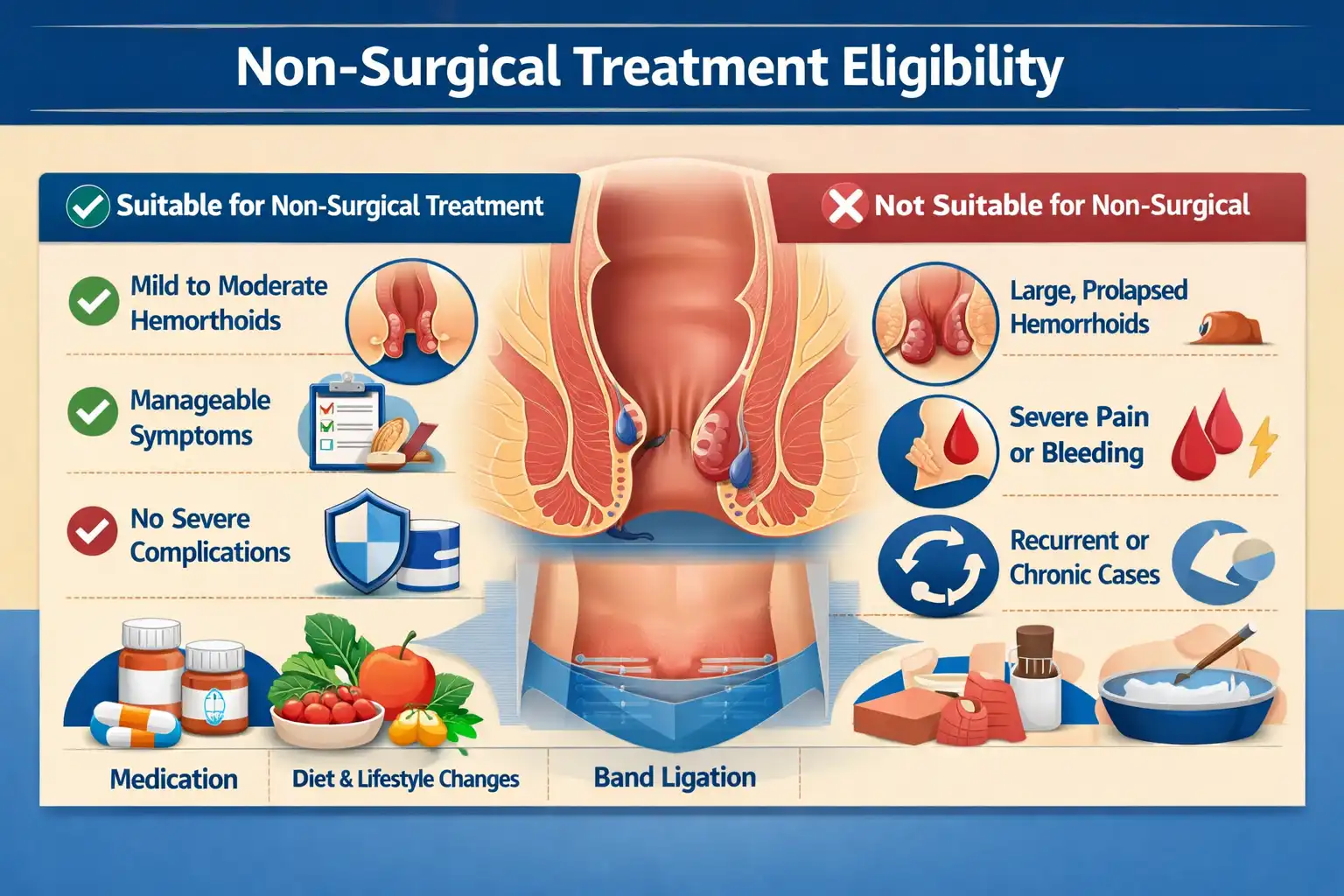
In my clinical experience, patients suitable for non invasive piles treatment typically have Grade 1 haemorrhoids with intermittent bleeding but no prolapse, Grade 2 haemorrhoids that reduce spontaneously after bowel movements, or patients where surgery carries high risk — elderly patients with significant cardiac or pulmonary conditions where anaesthesia risk is elevated.
Patients who are NOT good candidates for non-invasive treatment include those with Grade 3 piles that require manual reduction, Grade 4 permanently prolapsed piles, and patients with significant complications like thrombosis, strangulation, or heavy chronic bleeding causing anaemia. For laser piles surgery at Karachi Piles Clinic, eligibility must be assessed by a specialist.
What Are the Main Non-Invasive Procedures Used for Eligible Piles Patients?
The main non-invasive or minimally invasive procedures I use include:
- Rubber band ligation — places a tight elastic band at the base of the pile. Blood supply is cut, pile shrinks and falls off in 7 to 10 days. Excellent for Grade 2
- Sclerotherapy — phenol injection shrinks the pile. Best for small Grade 1 haemorrhoids, especially in patients on anticoagulants
- Infrared coagulation — heat coagulates the blood supply. Quick in-clinic procedure, no anaesthesia
- Haemorrhoidal artery ligation (HALO/THD) — Doppler-guided stitching of the blood vessels feeding the pile. Effective for Grade 2–3
See laser treatment options for when laser takes over from these approaches. Also see evidence-based piles therapy for outcome data on each technique.
How Does Rubber Band Ligation Compare to Sclerotherapy for Non-Invasive Care?
| Rubber Band Ligation | Sclerotherapy Injection |
|---|---|
| Grade 2–3 suitable | Grade 1–2 suitable |
| Band placed around pile base | Chemical injected into pile |
| Mild discomfort for 24–48 hrs | Very minimal discomfort |
| Single or 2 sessions usually | May need 2–3 sessions |
| Higher success rate for Grade 2 | Better for anticoagulated patients |
In my practice, rubber band ligation is my go-to non-invasive option for Grade 2 piles that are not suitable for or do not want laser surgery yet. Sclerotherapy I use more for Grade 1 or for patients where banding is not feasible. Kya aapne pehle rubber band treatment ke baare mein suna hai? Many patients in Karachi have not — because general physicians rarely discuss it.
What Results Can Patients Expect From Non-Invasive Piles Treatment?
For appropriate candidates, the results are very good. Rubber band ligation has a success rate of around 80 to 90 percent for Grade 2 piles in the short term. Long-term, piles can recur — especially if the underlying dietary and lifestyle factors are not addressed. Sclerotherapy has a lower immediate success rate but is extremely safe and repeatable.
The key message — non-invasive treatment works well when used for the right grade. It fails when used for grades beyond its effective range. For specialist consultation and hemorrhoid management resources, both are useful starting points for understanding your options fully.
Non-invasive piles treatment is not a compromise — it is the preferred option when appropriate. The goal is always the least intervention that achieves lasting relief. Getting the eligibility right is what makes that possible.
Book Your Consultation
Ready to book a consultation at Karachi Piles Clinic?
WhatsApp me directly on 0333-2877351. OPD timings: Tuesday, Thursday, Saturday — 5:00 PM to 8:00 PM at Karachi Piles Clinic, in Hill Park General Hospital, Shaheed-e-Millat Road, Karachi. Consultation fee Rs. 2,000.
🔗 Related Articles
🤔 Free Tool
Not Sure What Your Symptoms Mean?
Take our free 10-question symptom checker. Get an instant result — Piles, Fissure, Fistula, or Pilonidal Sinus — with treatment options and estimated cost.
▶ Start the Free Symptom QuizUnder 2 minutes · Free · Instant result · No login required