“Doctor, mujhe injection wala ilaj zyada pasand hai — surgery se darta hun.” I hear this often. And injection treatment — formally called sclerotherapy — is a legitimate, well-established option for certain grades of piles. But is piles sclerotherapy treatment still used today when we have rubber band ligation and laser? Yes — and I will explain exactly when and why.
What Is Piles Sclerotherapy Treatment and How Does It Work?
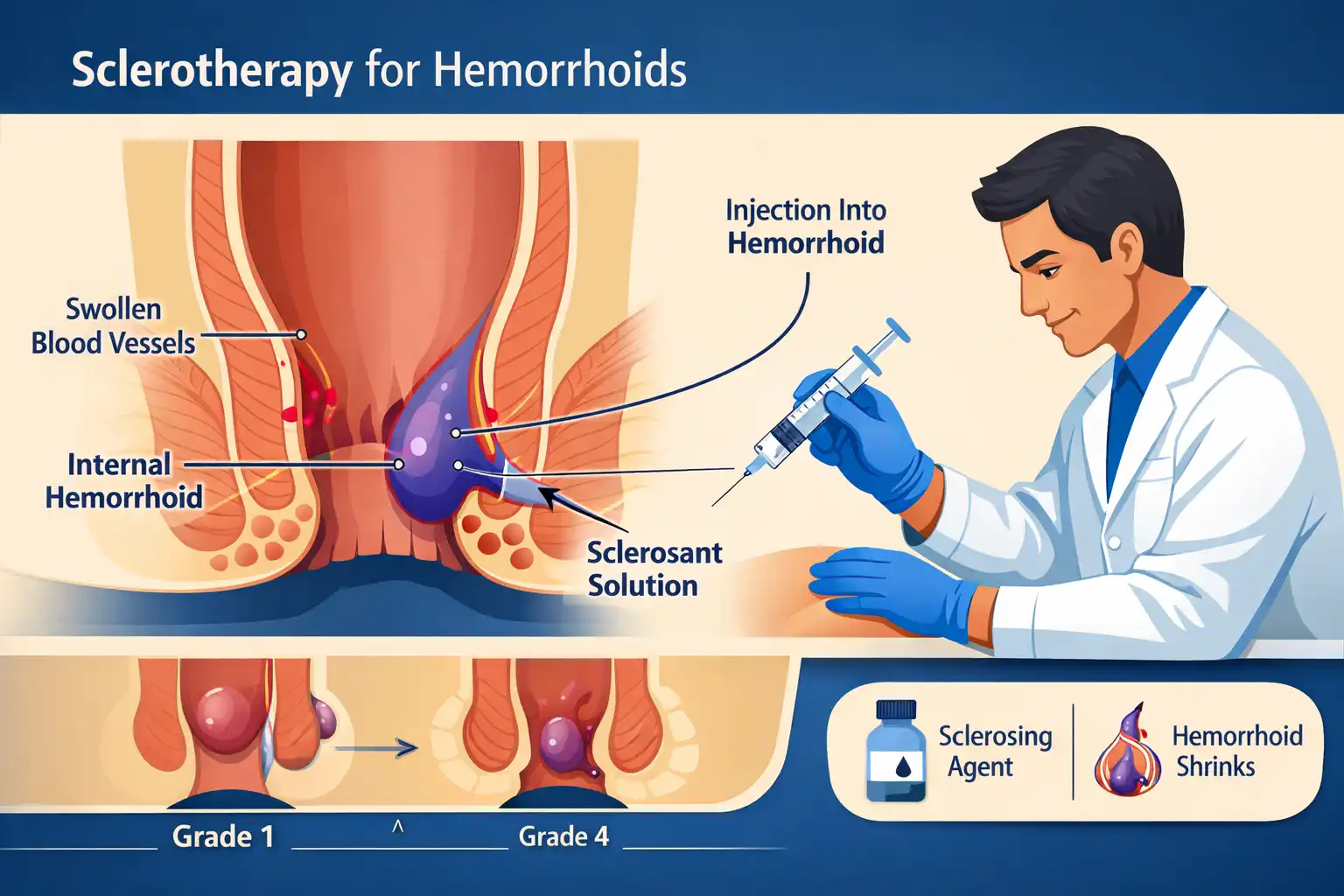
Piles sclerotherapy treatment involves injecting a chemical solution — typically 5% phenol in almond oil — directly into the base of an internal haemorrhoid. This chemical causes the blood vessels in the pile to harden (sclerose) and scar, cutting off its blood supply. The pile then gradually shrinks over 4 to 6 weeks.
The procedure takes 3 to 5 minutes per pile. It is done without anaesthesia because the injection goes into the submucosal layer — above the dentate line — where there are no pain nerve endings. Patients feel pressure but not pain. For laser piles treatment information and understanding where sclerotherapy fits, a proper consultation is always the starting point.
For Which Grade of Piles Is Sclerotherapy Most Effective?
| Grade | Sclerotherapy Effectiveness | Better Alternative |
|---|---|---|
| Grade 1 | Excellent — first-line option | — |
| Grade 2 | Good for small, non-prolapsing piles | Rubber band ligation |
| Grade 3 | Limited — may need multiple sessions | Laser procedure |
| Grade 4 | Not suitable | Surgery required |
In my practice, I use sclerotherapy most commonly for Grade 1 bleeding piles, for patients on blood thinners (anticoagulants) where rubber banding carries a bleeding risk, and for elderly patients who are not fit for procedures under anaesthesia. It is also useful when a patient refuses any procedure but needs something beyond just creams.
Is Sclerotherapy Injection Still Relevant When Laser Piles Treatment Exists?
Absolutely yes. Laser is not always necessary. For Grade 1 piles with simple bleeding and no prolapse — sclerotherapy is cheaper, quicker, equally effective, and avoids any procedure room setup. In my opinion, using laser on a Grade 1 pile is like using heavy artillery for a small problem. Sclerotherapy fits perfectly here.
The role of sclerotherapy in modern proctology is as a targeted, low-tech solution for the appropriate grade. It still has a very valid place. See laser treatment for when you need to step up, and evidence-based piles therapy for comparative outcome data. Also see piles assessment booking to find out which option applies to your case.
What Are the Risks and Side Effects of Piles Sclerotherapy Treatment?
Sclerotherapy is one of the safest procedures in anorectal medicine. The risks are minimal. Temporary mild discomfort or heaviness after the procedure lasts 24 to 48 hours. Very rarely, the injection can be placed incorrectly, leading to a chemical ulcer or infection — but this is uncommon in experienced hands.
In patients on blood thinners, sclerotherapy is actually preferred over rubber banding because it does not cut off blood supply in a way that risks delayed haemorrhage. The trade-off is slightly lower long-term success rate — but the safety profile is better. Kya aap blood thinner le rahe hain? Ye aapke treatment options ko affect karta hai — aur doctor ko zaroor batayein. See bawaseer ka ilaj resources for more on safe treatment in Pakistani patients with multiple conditions.
Sclerotherapy is not outdated — it is appropriately used. When the grade is right and the patient profile fits, it remains one of the simplest and most comfortable piles treatments available. No hospital, no anaesthesia, no incision. Just a targeted injection that solves a targeted problem.
Book Your Consultation
Got questions for Pakistan’s first laser proctologist?
WhatsApp me directly on 0333-2877351. OPD timings: Tuesday, Thursday, Saturday — 5:00 PM to 8:00 PM at Karachi Piles Clinic, in Hill Park General Hospital, Shaheed-e-Millat Road, Karachi. Consultation fee Rs. 2,000.
🔗 Related Articles
🤔 Free Tool
Not Sure What Your Symptoms Mean?
Take our free 10-question symptom checker. Get an instant result — Piles, Fissure, Fistula, or Pilonidal Sinus — with treatment options and estimated cost.
▶ Free Symptom Check — Start NowUnder 2 minutes · Free · Instant result · No login required