“Mera pila kaunse grade ka hai?” — When a patient asks me this, I know they have been doing their research. Good. Understanding piles grading gives patients context for their diagnosis and helps them understand why their treatment plan is what it is. Let me explain piles grading diagnosis in the simplest possible terms — because this is not complicated, but it is important.
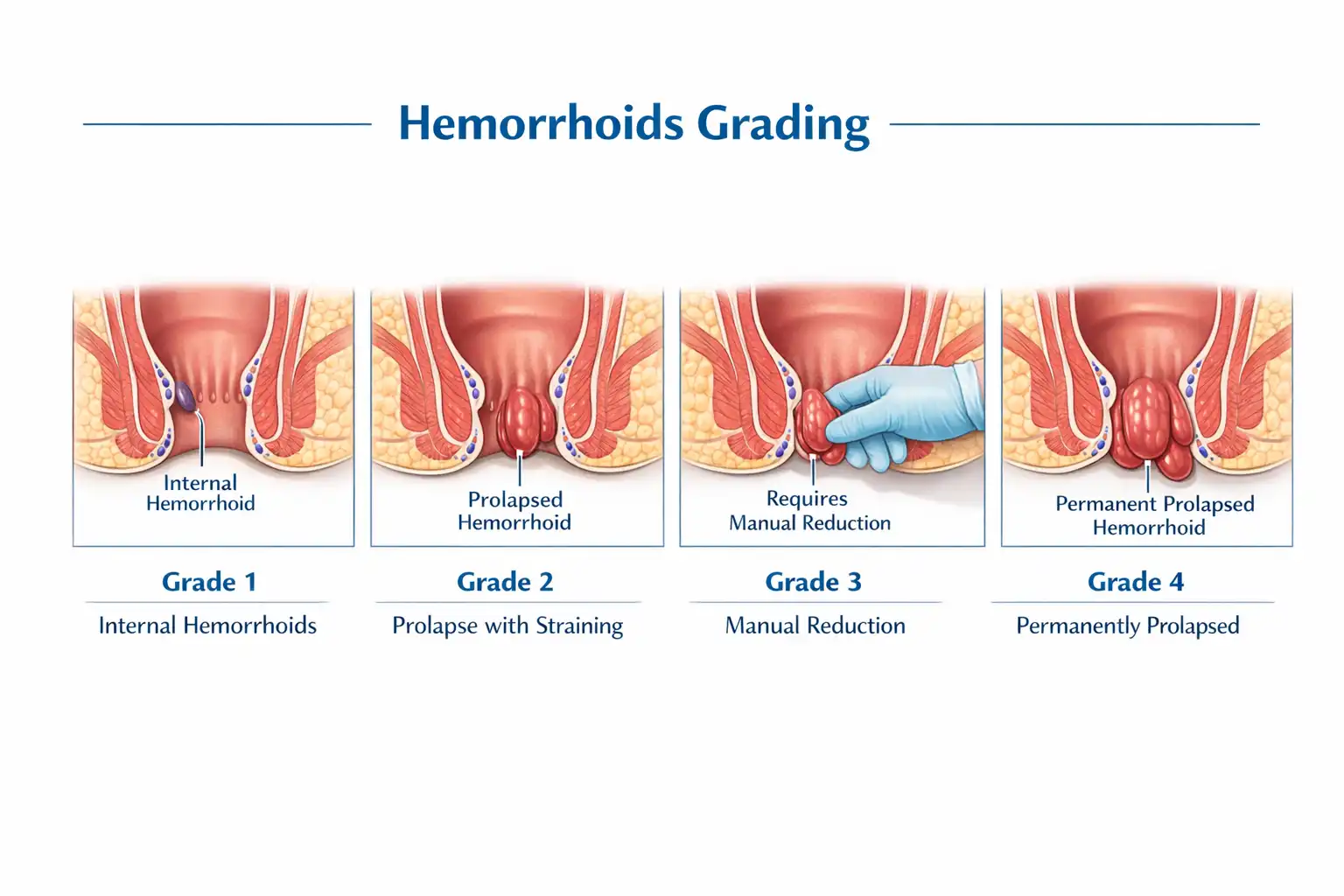
What Are the Grades of Piles and How Is Each One Defined?
Piles are classified into four grades based on the degree of prolapse — how much the haemorrhoidal tissue projects beyond the anus:
- Grade 1 — internal haemorrhoids that bleed but do not prolapse. Visible only on proctoscopy or anoscopy
- Grade 2 — prolapse during straining or defecation but reduce spontaneously afterward
- Grade 3 — prolapse during defecation and require manual reduction (the patient pushes them back in)
- Grade 4 — permanently prolapsed, cannot be reduced manually. External haemorrhoids and mixed (internal and external) haemorrhoids are also often classified here
This piles grading diagnosis system was developed by surgeons specifically to standardise treatment decisions. Without it, treatment is guesswork. For Karachi Piles Clinic’s laser piles procedure, grading is always the starting point.
How Does a Doctor Grade Piles During a Clinical Examination?
The grading process happens in two parts. First, the history: Does tissue come out during bowel movements? Does it go back in on its own, or do you have to push it? Has it ever been stuck outside permanently? These questions alone often suggest the grade before examination begins.
Then the examination confirms it. Visual inspection shows external haemorrhoids and any visible prolapse. A digital rectal exam assesses tone and feels for internal masses. Proctoscopy directly visualises the internal haemorrhoids — their size, location, and degree of prolapse into the scope. The combination of history and examination gives a definitive grade in most cases. See piles physical exam guide for what to expect during examination.
Worried about your piles grade?
Describe your symptoms to Dr. Abdullah Iqbal’s team on WhatsApp and get guidance on whether you need a checkup. OPD: Tue, Thu & Sat — 5:00–8:00 PM, Shaheed-e-Millat Road, Karachi.
💬 WhatsApp the ClinicWhat Does Each Grade of Piles Look Like and Feel Like for the Patient?
| Grade | What Patient Notices | What Doctor Sees |
|---|---|---|
| Grade 1 | Bright red bleeding, no lump | Enlarged internal cushions on proctoscopy |
| Grade 2 | Lump appears then disappears after motion | Prolapse into anoscope, reduces on its own |
| Grade 3 | Lump stays out, patient pushes it back | Prolapsed tissue requiring manual reduction |
| Grade 4 | Permanent lump outside, cannot push back | Permanently prolapsed, ulcerated if long-standing |
This table helps patients understand their own experience in clinical terms. Many patients who say “masa bahar aata hai phir chala jata hai” are describing Grade 2. “Mujhe khud andar karna padta hai” is Grade 3. See bawaseer ka ilaj for Urdu language grading explanation. Also see evidence-based piles therapy.
Can Piles Grade Change Over Time Without Treatment?
Yes — and always in the wrong direction. Without treatment, Grade 1 can become Grade 2. Grade 2 can become Grade 3. Grade 3 can progress to Grade 4. The haemorrhoidal tissue gradually enlarges, the supporting ligaments stretch, and the prolapse becomes more permanent. This progression takes months to years — but without lifestyle change and treatment, it is almost inevitable.
The opposite is not true. Grade 3 does not spontaneously become Grade 2. The progression is one-directional without intervention. Kya aap apna grade jaante hain? Is this the same experience you have had with your symptoms worsening over time? See specialist consultation and hemorrhoid treatment resources.
Understanding your piles grade is not a medical detail — it is the foundation of your entire treatment decision. Know your grade. Know your options. Then make an informed choice with your specialist.
Related Reading
- modern piles treatment approaches
- preventive care strategies
- how piles are assessed in the clinic
- treatment options for stage 2 piles
- when to call your surgeon after piles surgery
External Resources
Which Grade of Piles Needs Which Treatment?
Once a grade is established, the treatment decision follows a clear logic. Grade-matched treatment is the foundation of good proctology — using surgery for Grade 1 or cream alone for Grade 4 are both errors that waste time and money. Every grade has a first-line treatment and a fallback if that fails.
| Piles Grade | Key Feature | First-Line Treatment | If First-Line Fails |
|---|---|---|---|
| Grade 1 | Bleeding, no prolapse | Diet + flavonoids + sclerotherapy | Rubber band ligation |
| Grade 2 | Prolapse reduces spontaneously | Rubber band ligation | Laser haemorrhoidoplasty |
| Grade 3 | Requires manual reduction | Laser haemorrhoidoplasty | Open haemorrhoidectomy |
| Grade 4 | Permanently prolapsed | Open or laser surgery | Staged procedures if complex |
The escalation across grades is consistent. What does not change is the principle: the intervention must match the severity. Under-treating Grade 3 with cream produces no benefit. Over-treating Grade 1 with surgery causes unnecessary risk and recovery. The grade is the map — without it, every treatment decision is a guess.
Can Grade 3 Piles Be Treated Without Open Surgery?
Yes — and this is one of the most important advances in modern proctology for patients who fear surgery. In my practice, the majority of Grade 3 piles are now treated with laser haemorrhoidoplasty rather than open haemorrhoidectomy. The laser targets and shrinks the internal blood supply of the haemorrhoid without making large external incisions.
The outcomes in terms of pile resolution are comparable — but post-operative pain is significantly less and recovery is measured in days rather than weeks. Most Grade 3 laser patients return to desk work within three to five days. Open haemorrhoidectomy typically requires two to three weeks. For patients who have delayed specifically because they fear surgery, Grade 3 laser treatment removes most of that barrier.
What Happens When the Wrong Treatment Is Used for the Wrong Grade?
Two mismatches I see regularly in new patients. First: Grade 1 patients told they need surgery — frightened by an unnecessary recommendation from a non-specialist, and spending months or years avoiding treatment because of that fear. Second: Grade 4 patients given only topical cream after a brief GP visit, with no improvement over months, arriving at my clinic having wasted precious time with treatment that had no chance of working at their grade.
Both are preventable. Grade-matched treatment by a qualified specialist prevents both errors. The grade determines everything that follows — which is why establishing it through proper examination is not optional. Kya aapko kabhi bhi apna grade bataya gaya? If not — that is the first thing to establish.
Book Your Consultation
Want to discuss your symptoms with Dr. Abdullah Iqbal?
WhatsApp me directly on 0333-2877351. OPD timings: Tuesday, Thursday, Saturday — 5:00 PM to 8:00 PM at Karachi Piles Clinic, in Hill Park General Hospital, Shaheed-e-Millat Road, Karachi. Consultation fee Rs. 2,000.
🔗 Related Articles
🤔 Free Tool
Not Sure What Your Symptoms Mean?
Take our free 10-question symptom checker. Get an instant result — Piles, Fissure, Fistula, or Pilonidal Sinus — with treatment options and estimated cost.
▶ Free Symptom Check — Start NowUnder 2 minutes · Free · Instant result · No login required