“Doctor, rubber band wala procedure — kya dard hoga?” This is almost always the first question when I explain piles banding procedure to a patient. And I understand the hesitation — the idea of a rubber band being placed on a sensitive area sounds uncomfortable. Let me explain what actually happens, because the reality is much more manageable than most patients fear.
Is the Piles Banding Procedure Painful and What Does It Actually Feel Like?
The piles banding procedure — formally called rubber band ligation — is performed on internal haemorrhoids that sit above the dentate line in the anal canal. Above this line, there are no somatic pain nerve fibres. This means the banding itself is not felt as pain. Patients feel a sensation of pressure or fullness during the procedure, but not sharp pain.
After the procedure, some patients experience a dull aching or heaviness for 24 to 48 hours. Simple paracetamol manages this well. Severe pain after banding is uncommon — if it occurs, it usually means the band was placed too low, near the sensitive zone. This is why experience matters. For advanced laser piles care, band placement must be precise.
How Does Rubber Band Ligation for Piles Actually Work Step by Step?
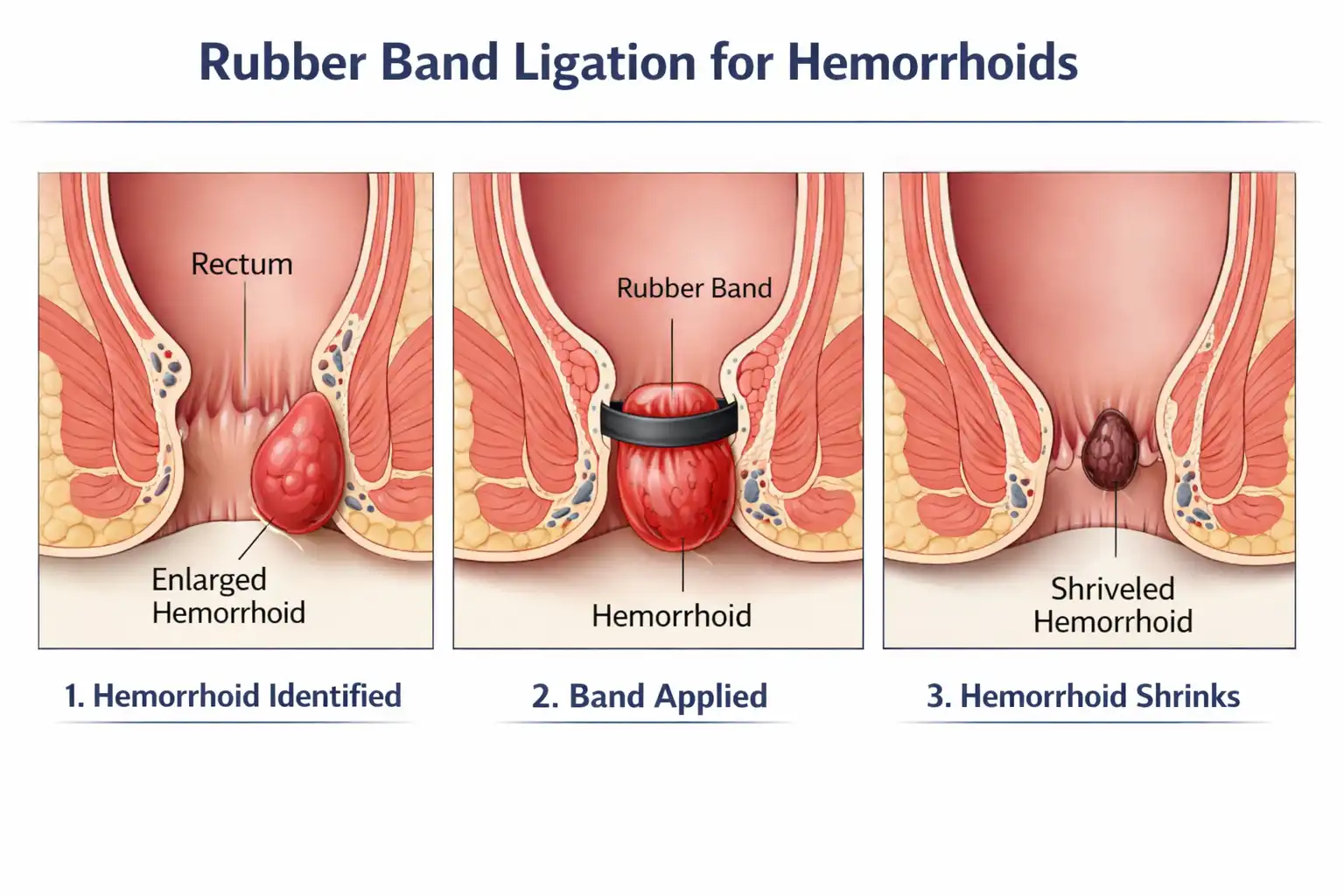
The procedure is straightforward. The patient lies in the left lateral position. A proctoscope is inserted to visualise the internal haemorrhoid. A banding device — either a ligator gun or suction ligator — is used to place a tight elastic band at the base of the pile, just above the dentate line.
The band cuts off the blood supply to the pile. Over the next 7 to 10 days, the pile shrinks and the necrotic tissue falls off during a bowel movement — often without the patient noticing. The whole in-clinic procedure takes about 5 to 10 minutes. No incision. No stitches. No anaesthesia. The patient can go home immediately. See our procedures and hemorrhoid treatment resources for comparison with laser options.
How Does Piles Banding Compare to Laser Surgery for Grade 2 and 3 Piles?
| Rubber Band Ligation | Laser Haemorrhoidoplasty |
|---|---|
| No anaesthesia needed | Local or general anaesthesia |
| 5–10 minutes, in-clinic | 20–30 minutes, procedure room |
| Grade 2, some Grade 3 | Grade 2, 3, and 4 |
| Higher recurrence at Grade 3 | Lower recurrence rate overall |
| Lower immediate cost | Higher upfront, better long-term |
For Grade 2 piles, I often offer rubber banding as the first-line procedure. If it resolves the problem — excellent. If piles recur within 12 to 18 months, we step up to laser. This gives patients the least invasive effective option first. Is this the same approach your doctor has discussed with you? Kya aapko ye options bataye gaye the?
What Should You Do and Avoid After the Piles Banding Procedure?
After banding, I advise patients to: eat a high-fibre diet to keep stool soft, drink plenty of water, avoid heavy lifting or straining for 1 week, take warm sitz baths twice daily for comfort, and use simple paracetamol if there is aching. Avoid aspirin and ibuprofen for the first week as they increase bleeding risk.
A small amount of bleeding when the pile falls off — around day 7 to 10 — is expected. Heavy bleeding that soaks through clothing or lasts more than 30 minutes should be reported immediately. See specialist consultation for post-procedure guidance, and bawaseer ka ilaj for Urdu-language post-procedure care tips.
Rubber band ligation is one of the most effective, quick, and accessible piles treatments available. The fear of pain is usually much greater than the reality of the procedure. One properly done banding session can give months or years of relief from bleeding piles.
Book Your Consultation
Considering laser treatment? Let’s talk about your case.
WhatsApp me directly on 0333-2877351. OPD timings: Tuesday, Thursday, Saturday — 5:00 PM to 8:00 PM at Karachi Piles Clinic, in Hill Park General Hospital, Shaheed-e-Millat Road, Karachi. Consultation fee Rs. 2,000.
🔗 Related Articles
🤔 Free Tool
Not Sure What Your Symptoms Mean?
Take our free 10-question symptom checker. Get an instant result — Piles, Fissure, Fistula, or Pilonidal Sinus — with treatment options and estimated cost.
▶ Check Your Symptoms FreeUnder 2 minutes · Free · Instant result · No login required