“Doctor, motion ke baad itna dard hota hai ke bas lagta hai kuch phat gaya.” This is how patients describe it to me. Severe pain after a bowel movement — sharp, burning, lasting anywhere from minutes to hours afterward. This symptom is one of the most distinctive in anorectal medicine, and in my experience, it almost always points to one specific diagnosis: an anal fissure, not piles.
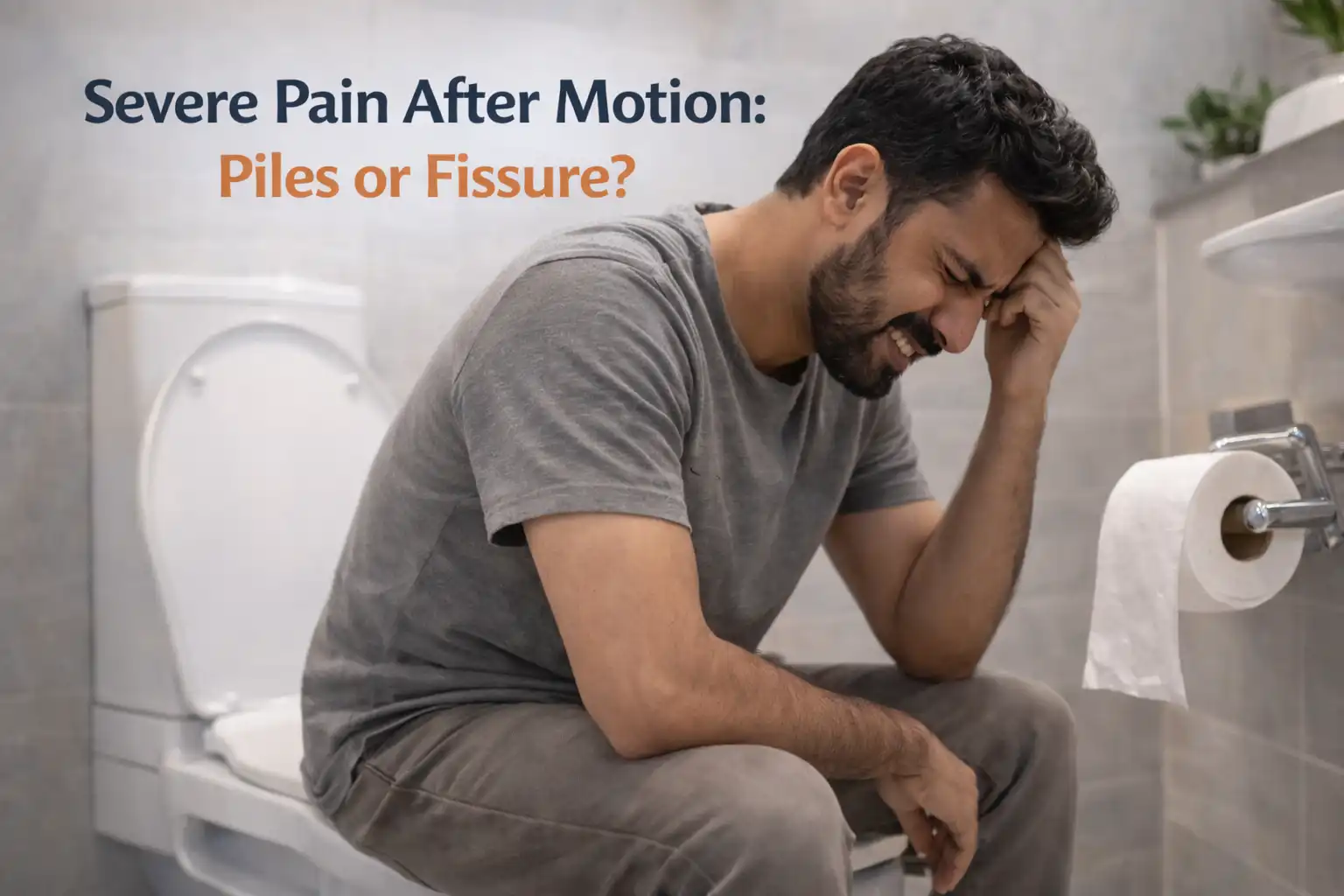
Is Severe Pain After Motion Caused by Piles or by a Fissure?
In most cases, severe pain immediately after a bowel movement is caused by an anal fissure. Piles can cause discomfort and dull aching, but they rarely produce this kind of sharp, tearing, burning pain that comes on at the moment of defecation and persists afterward. A fissure is a small tear in the lining of the anal canal — and every bowel movement stretches that tear open again. Anal fissure treatment is very different from piles treatment, which is why correct diagnosis matters enormously here.
For laser hemorrhoidopexy at Karachi Piles Clinic and fissure diagnosis, please do not assume based on symptoms alone. A brief examination settles the question immediately.
How Does Anal Fissure Pain Feel Compared to Piles Pain?
| Anal Fissure Pain | Piles Pain |
|---|---|
| Sharp, tearing, burning sensation | Dull ache, pressure, or throbbing |
| Starts during or immediately after motion | Can occur independently of bowel movements |
| Can last 30 minutes to several hours | Usually brief after motion |
| Often worse with hard stool | Can occur with any stool consistency |
| Bright red blood sometimes, on paper | Bright red blood, can be more than fissure |
This table shows the key clinical differences. When a patient describes that post-motion burning that lasts an hour, my index of suspicion for fissure is very high. See fissure management options for a detailed comparison.
What Is the Right Anal Fissure Treatment for Chronic Post-Motion Pain?
Treatment depends on how long the fissure has been present and whether it is acute or chronic. Acute fissures — present less than 6 weeks — often respond to conservative management. Chronic fissures — present longer — usually require more active intervention.
For acute fissures, I typically recommend: warm sitz baths, high-fiber diet and adequate hydration to soften stool, topical anaesthetic creams for symptom relief, and nitrate or calcium channel blocker creams to relax the anal sphincter. These work well in the majority of acute cases.
For chronic fissures, the options include botulinum toxin injection — Botox into the sphincter — which relaxes the muscle and allows healing. Or a laser fissure procedure, which I find gives excellent results with minimal recovery. In my experience, laser anal fissure treatment for chronic cases has a very high success rate. Visit fissure management options to learn what the procedure involves.
Why Does a Painful Bowel Movement Specialist Sometimes Refer to a Fissure as a Chronic Anal Crack?
The term “chronic anal crack” or “chronic fissure” simply means the tear has been present long enough that the body has built up scar tissue around it — called a sentinel tag — and the tear no longer heals on its own. The sphincter muscle goes into spasm with each bowel movement, cutting off blood supply to the area and preventing healing. It becomes a vicious cycle.
Breaking that cycle requires something to relax the sphincter — either medication, botulinum toxin, or surgery. Simple dietary changes at this stage are not enough. I have seen patients suffer with chronic fissure pain for 2 to 3 years because they were not told this clearly enough early on. See renowned proctology specialist resources for expert-level guidance on chronic fissure management.
When Should You See a Specialist for Post-Motion Pain Without Further Delay?
Come in right away if the pain is so bad that you are delaying or avoiding bowel movements. This is a serious red flag. Avoiding defecation causes constipation, harder stool, and even worse pain next time — a vicious downward spiral that I have seen cause significant suffering in patients.
Also come in immediately if there is significant bleeding with the pain, if you have had the pain for more than 4 weeks with no improvement, or if you notice a lump forming near the anal opening (sentinel pile). Also see advanced fistula treatment in case the diagnosis turns out to be a fistula rather than fissure — the two can sometimes co-exist.
Motion ke baad ka dard normal nahi hai. You do not have to live with it. With the right diagnosis and treatment, most fissure patients are significantly better within 4 to 6 weeks. The first step is just coming in.
🤔 Free Tool
Not Sure What Your Symptoms Mean?
Take our free 10-question symptom checker. Get an instant result — Piles, Fissure, Fistula, or Pilonidal Sinus — with treatment options and estimated cost.
▶ Free 2-Minute Symptom QuizUnder 2 minutes · Free · Instant result · No login required
Book Your Consultation
Got questions for Pakistan’s first laser proctologist?
WhatsApp me directly on 0333-2877351. OPD timings: Tuesday, Thursday, Saturday — 5:00 PM to 8:00 PM at Karachi Piles Clinic, in Hill Park General Hospital, Shaheed-e-Millat Road, Karachi. Consultation fee Rs. 2,000.
🔗 Related Articles
🔗 Related Articles