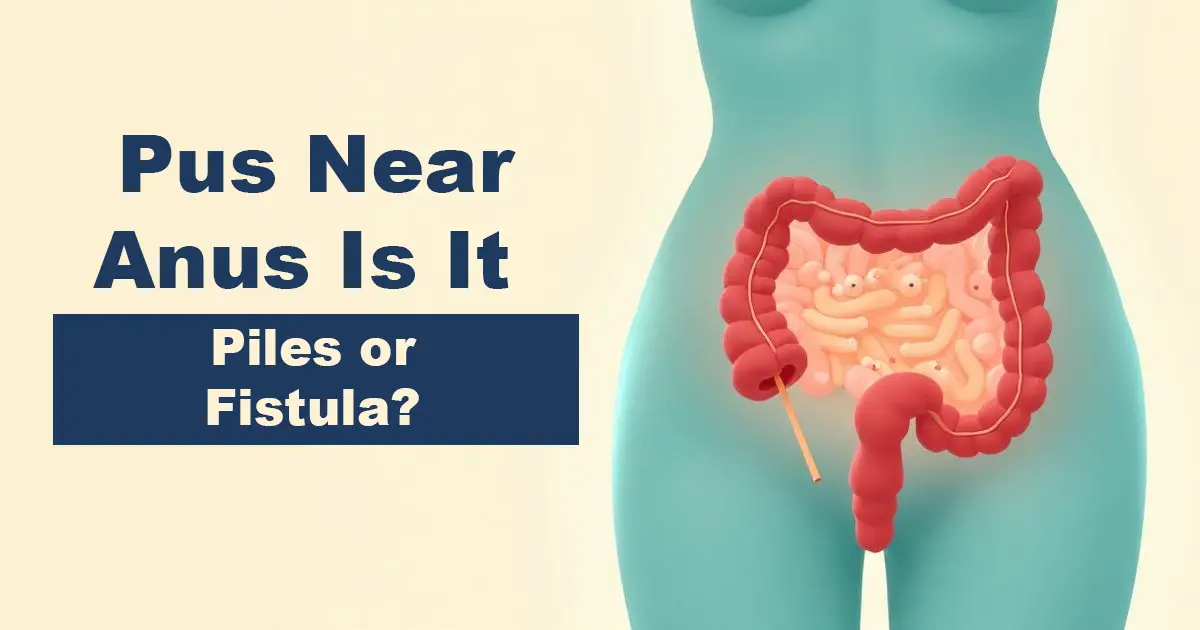
Pus near anus is a symptom I take very seriously every time a patient walks into Karachi Piles Clinic. Pus near the anus is one symptom that should never be ignored. Every week I see patients who have been applying pile ointment for months, completely unaware that what they actually have is an anal fistula. The pus keeps coming back, the area stays uncomfortable, and the real cause remains unaddressed. Let me clear this up properly.
What Does Pus Near the Anus Actually Mean?
Pus means infection. When you see yellowish, cloudy or foul-smelling discharge near the anus, it is almost always coming from an infected structure. Simple piles — hemorrhoids — do not produce pus. They can produce blood and mucus, but not pus. So if you are seeing pus, the first thing to rule out is an anal fistula or a perianal abscess.
An anal fistula is a small tunnel that forms between the inside of the anal canal and the skin outside. This tunnel — the fistula tract — fills with debris and infected fluid, which then drains as pus through a small opening near the anus. It can be intermittent or continuous.
Can Regular Piles Actually Cause Pus Discharge?
In my opinion — and in clear clinical terms — no. Simple hemorrhoids do not produce pus. What piles can produce is blood and sometimes clear mucus from internal hemorrhoids. Pus means there is an active infection, and that means either an abscess (a pocket of pus that has collected) or a fistula (a track that keeps draining pus).
I have seen many patients who were diagnosed elsewhere as having “infected piles.” In most cases, when I examine them, they actually have a fistula. The fistula often starts as an abscess that was either not treated or was incompletely treated.
What Is Anal Fistula and How Does It Cause Persistent Pus?
A fistula forms like this: a small gland inside the anal canal gets blocked and infected. This forms an abscess. If the abscess is not properly drained — or if it drains on its own through the skin — it can leave behind a tunnel between the inside of the canal and the outside skin. That tunnel is the fistula.
This fistula tract keeps getting re-infected and producing pus. It may seem to get better for a few days, then start draining again. This cycle — discharge stops, swelling comes, discharge starts again — is very characteristic of fistula. A proper fistula pus drainage approach requires surgical treatment, not ointment.
For patients who want to understand more about diagnosis options, our detailed post on personalized piles treatment explains how conditions are evaluated before recommending any procedure.
| Feature | Piles (Bawaseer) | Anal Fistula |
|---|---|---|
| Discharge type | Blood or mucus | Pus, cloudy, foul |
| Small hole near anus | No | Yes — external opening |
| Recurrent swelling | Uncommon | Very common |
| Pain pattern | Straining-related | Constant, worse when blocked |
| Treatment | Medication or laser | Surgery required |
When Should You Urgently See an Anal Fistula Specialist?
You should see an anal fistula specialist urgently if: you have pus or discharge near the anus that keeps coming back, you have had a perianal abscess that was drained and now you have a persistent hole or discharge, you have fever along with swelling and pain near the anus, or you have been treating yourself for “piles” for more than 4 weeks with no improvement.
In my experience, the longer a fistula is left untreated, the more complex it becomes. Simple low fistulas are easy to treat. But if left for years, they can become high, branching and horseshoe-shaped fistulas that require much more complex procedures. Earlier is genuinely better here.
How Does Fistula Treatment Differ From Piles Treatment?
Completely different approach. Piles can sometimes be managed with rubber band ligation or injections. Fistula always requires surgery — there is no medication that closes a fistula tract. The type of surgery depends on where the fistula is and how complex the tract is.
The laser approach — FiLaC (Fistula-in-ano Laser Closure) — is a sphincter-preserving technique I use for appropriate fistula cases. A laser fibre is passed through the tract and as it is withdrawn, the laser energy destroys the tract lining from inside, causing it to close without cutting the sphincter muscle. Recovery is much faster than open fistula surgery. You can read more about how fistulas are managed in detail on our page about specialized anorectal conditions.
For patients with recurrent swelling alongside discharge, my diagnostic guide on red hot lump near anus — piles or abscess covers when a hot, painful lump actually means an infection rather than piles.
Pus near the anus is not piles. It is almost always fistula or abscess. Stop applying ointment and get a proper examination. Early fistula treatment is straightforward. Delay makes it complicated.
🤔 Free Tool
Not Sure What Your Symptoms Mean?
Take our free 10-question symptom checker. Get an instant result — Piles, Fissure, Fistula, or Pilonidal Sinus — with treatment options and estimated cost. For more on this, see our anal fissure laser service.
▶ Take the Free Symptom QuizUnder 2 minutes · Free · Instant result · No login required
Book Your Consultation
Got questions for Pakistan’s first laser proctologist?
WhatsApp me directly on 0333-2877351. OPD timings: Tuesday, Thursday, Saturday — 5:00 PM to 8:00 PM at Karachi Piles Clinic, in Hill Park General Hospital, Shaheed-e-Millat Road, Karachi. Consultation fee Rs. 2,000.
🔗 Related Articles