“Doctor, 63 saal ki umra hai — kya ab bhi theek ho sakta hai?” This question always makes me want to respond immediately and clearly: yes. Elderly piles treatment options are genuinely effective and the age of 60 or 65 is absolutely not a barrier to getting lasting relief. What changes at this age is the approach — more careful, more tailored — but the outcome potential remains very good.
What Are the Best Piles Treatment Options for Patients Over 60?
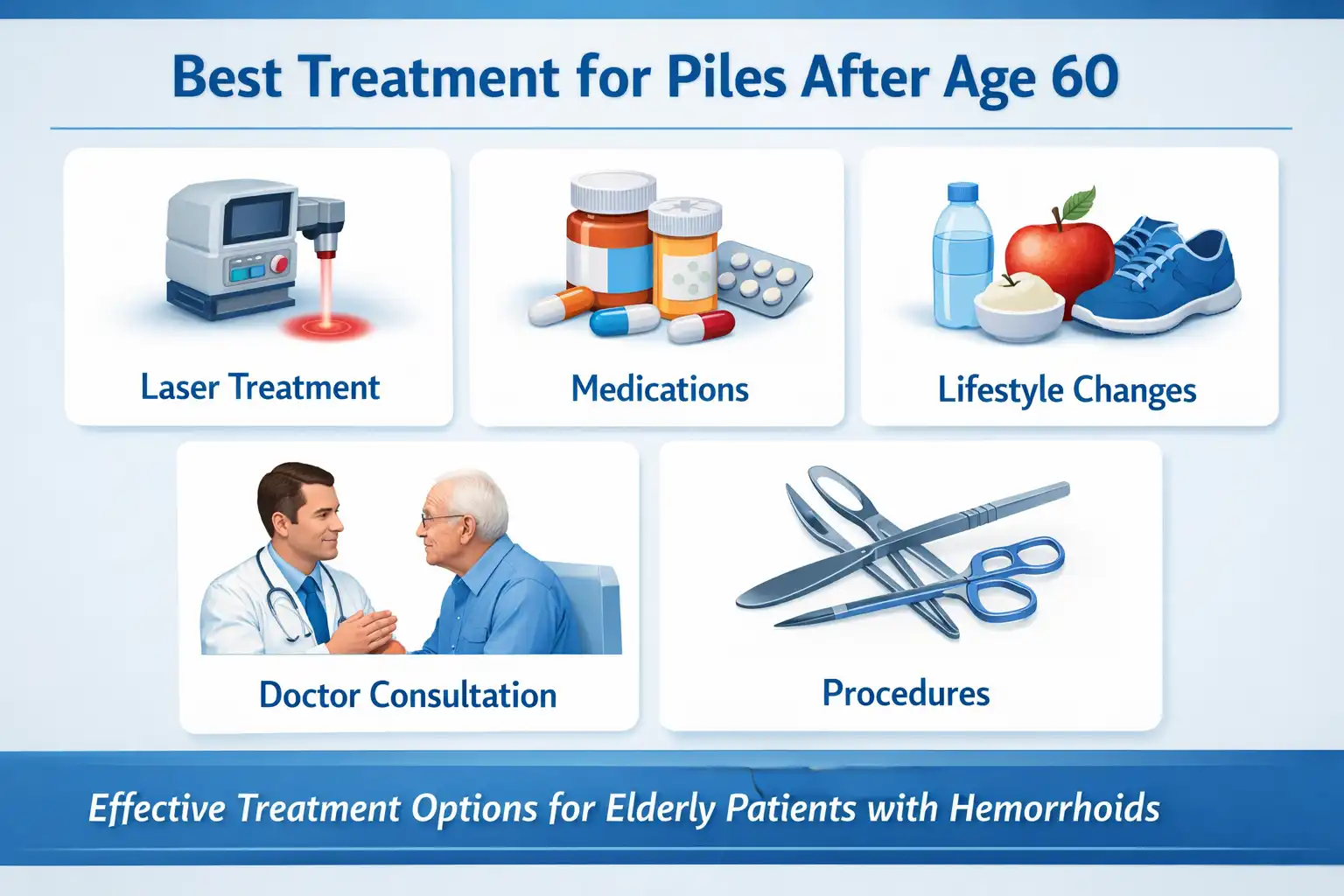
For patients over 60, the full treatment range remains available but the selection process is more nuanced. Grade 1 is managed conservatively — fibre, hydration, flavonoids — as in younger patients. Grade 2 is treated with rubber band ligation as the first line, which requires no anaesthesia and is very well-tolerated even in elderly patients. Grade 3 in a medically fit 65-year-old responds excellently to laser haemorrhoidoplasty with spinal anaesthesia. Grade 4 may require more detailed planning but is still surgically addressable in appropriate candidates.
The key difference in elderly piles treatment options is that I spend more time on the pre-operative assessment and comorbidity optimisation before proceeding to any procedure. For comprehensive piles care, older patients deserve the same quality of result — achieved through more careful preparation.
How Do Piles Treatment Outcomes Compare Between Younger and Older Patients?
| Factor | Under 60 | Over 60 |
|---|---|---|
| Procedure success rate | 85–95% | 80–92% (comparable with fit patients) |
| Recovery time | 3–5 days (laser) | 3–5 days (slightly longer) |
| Comorbidity management | Usually straightforward | More complex — diabetes, cardiac, anticoagulants |
| Wound healing | Normal | Slower if diabetic or nutritionally depleted |
| Long-term recurrence | 10–15% at 3 years | Similar, slightly higher if constipation persists |
The outcomes are genuinely comparable for fit elderly patients. The difference is in preparation and recovery speed — not in the ultimate result. See KPC piles consultation and bawaseer ka ilaj for elderly-specific guidance.
What Conservative Treatment Works Best for Elderly Piles Patients Who Cannot Have Surgery?
For elderly patients who are genuinely not fit for any procedure — very advanced cardiac disease, severe frailty, extremely poor surgical risk — conservative management focuses on maximising quality of life with symptoms. This means: optimal stool softening (ispaghol, lactulose), adequate hydration, sitz baths for acute flares, flavonoids for bleeding control, and topical preparations for discomfort.
The goal in this group is not cure — it is symptom control. And with proper conservative management, most elderly patients can achieve a significant reduction in symptoms even without procedures. This is still meaningful treatment that improves daily life. See evidence-based piles therapy and hemorrhoid treatment resources. Kya aapke ghar mein koi buzurg patient hai jis ne treatment avoid kiya hua hai? Ye unke liye bhi late nahi hai.
What Specific Medications Should Elderly Piles Patients Be Careful About?
Several medication classes common in elderly patients affect piles management. Anticoagulants (warfarin, rivaroxaban) and antiplatelet drugs (aspirin, clopidogrel) increase bleeding risk — any procedure must be carefully timed and coordinated with the prescribing doctor. NSAIDs like ibuprofen — commonly taken for joint pain — also increase bleeding risk and should be avoided around any anal procedure.
Iron supplements — often prescribed for the anaemia of chronic bleeding piles — can cause constipation, which worsens the piles that caused the anaemia in the first place. Stool softeners should always accompany iron supplementation in these patients. See is your symptom actually piles for self-assessment before consultation.
Is Laser Piles Surgery Specifically Safe for Patients Over 60?
Laser haemorrhoidoplasty is particularly well-suited to elderly patients for several reasons. It is performed under local or spinal anaesthesia rather than general anaesthesia in most cases — reducing cardiac and respiratory risk significantly. There is minimal blood loss, which matters for patients on anticoagulants or with lower haemoglobin. The procedure takes 20 to 30 minutes and most patients go home the same day — avoiding the complications of prolonged hospitalisation that elderly patients are more susceptible to.
The key preconditions are a proper pre-operative assessment: cardiac clearance if there is heart disease, blood pressure control, and a review of current medications. With these in place, age alone is not a contraindication to laser piles surgery.
Piles treatment after 60 is not second-rate treatment. With proper assessment and the right technique, elderly patients achieve excellent results. Do not let age become a reason to accept ongoing suffering — there is always a safe, appropriate treatment path available.
🤔 Free Tool
Not Sure What Your Symptoms Mean?
Take our free 10-question symptom checker. Get an instant result — Piles, Fissure, Fistula, or Pilonidal Sinus — with treatment options and estimated cost.
▶ Try the Free Symptom CheckerUnder 2 minutes · Free · Instant result · No login required
Book Your Consultation
Considering laser treatment? Let’s talk about your case.
WhatsApp me directly on 0333-2877351. OPD timings: Tuesday, Thursday, Saturday — 5:00 PM to 8:00 PM at Karachi Piles Clinic, in Hill Park General Hospital, Shaheed-e-Millat Road, Karachi. Consultation fee Rs. 2,000.
Surgical Risks After 60 — What Must Be Assessed First
Piles surgery in older patients carries the same considerations as any surgery in this age group: higher anaesthetic risk where cardiac or pulmonary disease exists, slower wound healing (especially in diabetics), and reduced physiological reserve for managing complications. These risks are real but manageable when identified beforehand — which is why individualisation matters more than age itself. A fit, active 70-year-old with no comorbidities tolerates laser haemorrhoidoplasty very well; a frail patient with cardiac stents and uncontrolled diabetes may need conservative management first, or the most minimally invasive option available.
The Pre-Operative Workup for Patients Over 60
Expect a broader workup than a younger patient would need: full blood count with coagulation profile, blood glucose and HbA1c, ECG with cardiology clearance where there is cardiac history, chest X-ray for respiratory conditions, renal function tests for those on long-term medication, and a structured review of the medicines discussed above. The workup itself takes one to two weeks, and optimisation — better sugar control, anaemia correction, cardiac medication adjustment — can add another two to four. That timeline is a feature, not a delay: rushing older patients to the operating room without assessment is how complications happen. The standard test list is in our pre-surgery tests guide.
🔗 Related Articles