Many patients ask me — how exactly do you grade piles? What happens during the examination? What does the doctor look for, and how does that translate into a Grade 1, 2, 3, or 4 classification? Understanding piles clinical examination demystifies the process and helps patients arrive at their appointment knowing what to expect. Let me walk through it step by step.
How Do Doctors Grade Piles During a Clinical Examination?
The piles clinical examination starts before any instruments are used. A detailed history is taken first: How long have symptoms been present? Is there bleeding, prolapse, pain, discharge? Does the patient manually reduce any prolapse? Has there been any previous treatment? This history alone often suggests the likely grade before examination begins.
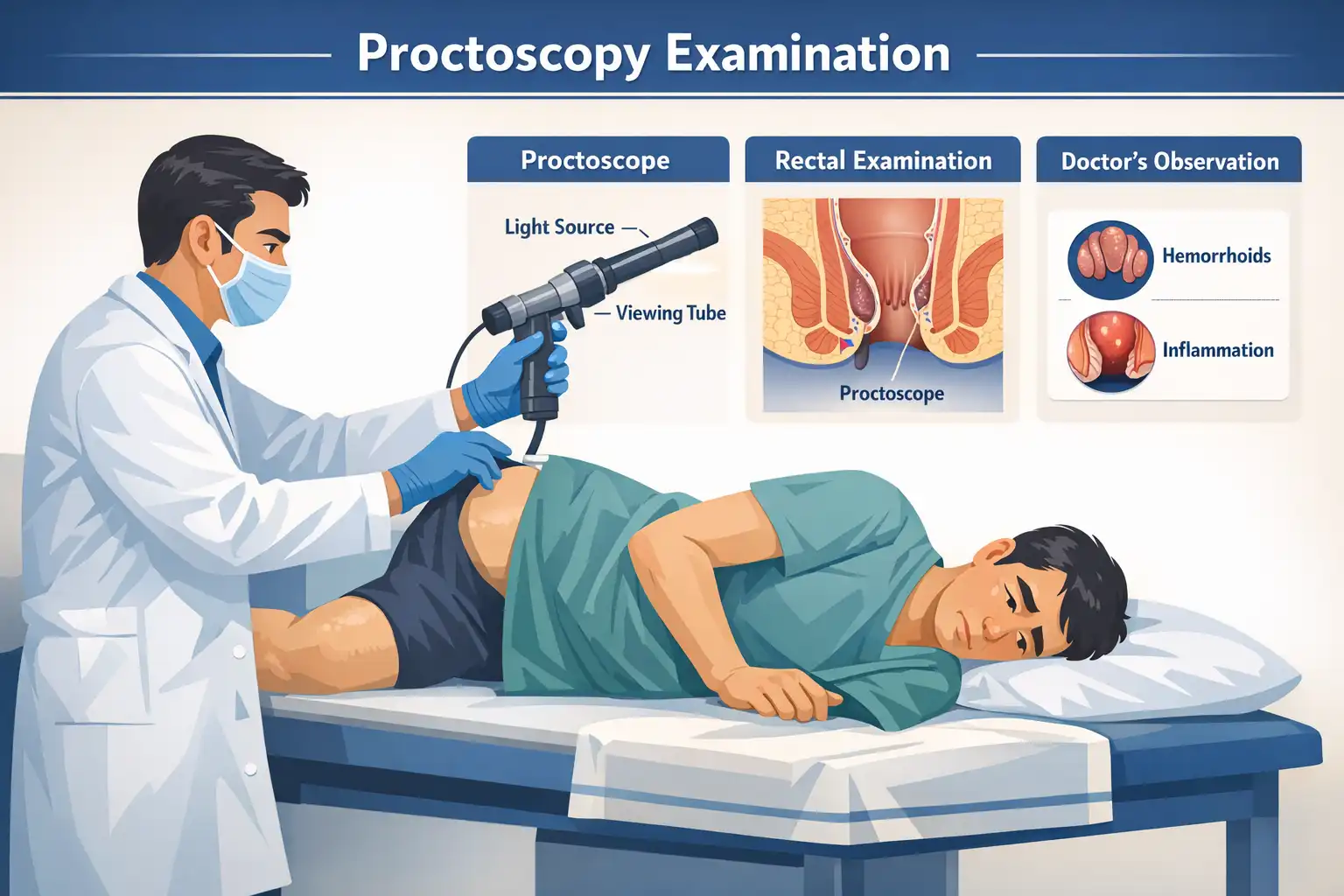
Then the examination proceeds in a systematic way. Visual inspection, digital rectal examination, and proctoscopy together give a complete picture. In my practice, I never skip any of these steps — each adds something the previous one cannot tell me. For specialist piles procedure in Karachi, a complete examination is non-negotiable before any treatment recommendation.
What Happens at Each Step of the Piles Clinical Examination?
- Visual inspection — patient positioned in left lateral (lying on side). The perianal skin is inspected for external haemorrhoids, skin tags, fissures, fistula openings, or prolapsed tissue. If prolapse is visible at rest, that suggests Grade 4
- Digital rectal examination (DRE) — gloved, lubricated finger inserted to assess sphincter tone, detect masses, tenderness, or blood. Internal Grade 1 haemorrhoids are not usually felt on DRE — they are too soft. But their effects — blood on the glove, tenderness — are noted
- Proctoscopy — a small hollow tube is inserted into the anal canal. On withdrawal with the patient bearing down, the internal haemorrhoids prolapse into the scope and their grade is directly observed. This is the definitive grading step
See piles physical exam guide for a patient-focused overview of what to expect during the visit. Also see evidence-based piles therapy for how examination findings translate to treatment.
What Does Each Grading Finding Look Like on Proctoscopy?
| What Doctor Sees on Proctoscopy | Grade |
|---|---|
| Engorged cushions visible inside scope, no prolapse | Grade 1 |
| Prolapse into scope on straining, reduces spontaneously | Grade 2 |
| Prolapse requires manual push to reduce | Grade 3 |
| Permanently outside, cannot be reduced | Grade 4 |
The proctoscope provides direct visualisation. There is no guesswork. The grade is assigned based on what is observed — not on symptoms alone. This is why the examination is so important and cannot be replaced by online tools or self-diagnosis. See piles or another anal condition for what symptoms suggest before you come in.
Is the Piles Examination Painful and Should You Be Nervous About It?
The most common thing I hear before an examination is: “Doctor, dard hoga?” And the most common thing I hear after: “Bas itna hi tha?” The examination is significantly less uncomfortable than most patients anticipate. The digital rectal exam causes mild pressure. The proctoscope causes a similar sensation to needing to go to the toilet — not pain. The whole examination takes 5 to 8 minutes.
For patients with active fissures or very tender external haemorrhoids, the examination may be more uncomfortable and I adjust accordingly. But for the vast majority of patients — the anticipation is worse than the reality. See bawaseer ka ilaj for further examination guidance in Urdu. Also see consultation page and hemorrhoid treatment resources. Kya aap examination se darte hain? Ye bahut normal baat hai — lekin haqeeqat mein ye utna bura nahi hota jitna lagta hai.
A piles clinical examination is the foundation of accurate diagnosis. Without it, treatment is guesswork. With it, every subsequent decision — the grade, the treatment plan, the expected outcome — becomes clear and confident. Five minutes of examination. Months of clarity. That is a very good trade.
Related Reading
- professional piles treatment options
- common piles questions answered
- piles grades 1 to 4 explained by stage
- grade 1 piles — what to do
- post-piles-surgery red flags
External Resources
🤔 Free Tool
Not Sure What Your Symptoms Mean?
Take our free 10-question symptom checker. Get an instant result — Piles, Fissure, Fistula, or Pilonidal Sinus — with treatment options and estimated cost.
▶ Start the Free Symptom QuizUnder 2 minutes · Free · Instant result · No login required
Book Your Consultation
Ready to book a consultation at Karachi Piles Clinic?
WhatsApp me directly on 0333-2877351. OPD timings: Tuesday, Thursday, Saturday — 5:00 PM to 8:00 PM at Karachi Piles Clinic, in Hill Park General Hospital, Shaheed-e-Millat Road, Karachi. Consultation fee Rs. 2,000.
🔗 Related Articles