“Doctor, kya bawaseer aur pilonidal sinus ek hi cheez hai?” I get this question surprisingly often. The answer is a firm no — they are completely different conditions. But I understand the confusion. Both involve the lower body. Both cause pain and swelling. And in Pakistan, both get called bawaseer by default. Let me explain the actual differences clearly, because understanding this changes how you approach treatment. Pilonidal sinus surgery is very different from piles surgery.
What Are the Key Differences Between Pilonidal Sinus and Piles?
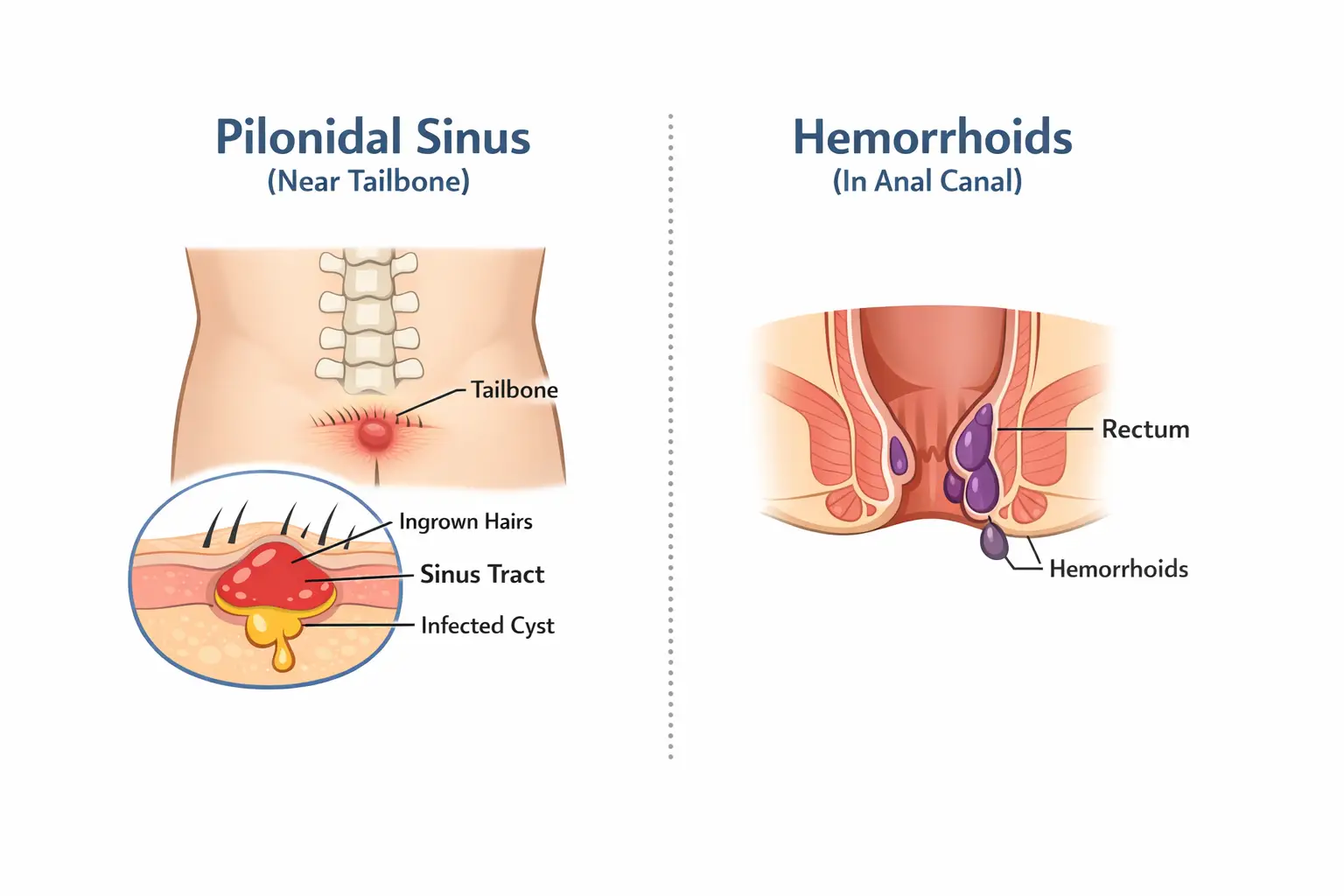
The most fundamental difference is location. Piles are inside or at the rim of the anus — they involve the anal blood vessels and rectal lining. Pilonidal sinus is at the top of the natal cleft, near the tailbone — it involves a hair-containing cyst or tunnel in the skin of the upper buttock crease. These are anatomically different areas of the body. The symptoms, causes, patient demographics, and treatments are all different.
Piles affect people of all ages, both genders. Pilonidal sinus predominantly affects young males between 15 and 35, especially those with coarse body hair or who sit for long hours. In Karachi’s urban population — with so many desk jobs and long commutes — pilonidal sinus is more common than many people realise. For personalized piles treatment versus pilonidal sinus surgery, these require completely different specialist approaches.
How Do the Symptoms of Pilonidal Sinus Compare to Piles Side by Side?
| Pilonidal Sinus | Piles (Haemorrhoids) |
|---|---|
| Pain and swelling near tailbone / coccyx | Pain, bleeding, or prolapse at anus |
| Discharge may contain hair | Bleeding — bright red, or mucus discharge |
| Not related to bowel movements | Symptoms worsen during or after motion |
| Common in young men 15–35 | Affects all ages and both genders |
| Sitting and friction worsen it | Constipation and straining worsen it |
| Requires excision or flap surgery | Requires rubber band / laser haemorrhoidoplasty |
This table should make it very clear. Not a single symptom overlaps perfectly. The confusion arises only because people do not know what pilonidal sinus is. Once you understand what it is and where it sits — the distinction becomes obvious. Also see fistula treatment approach as fistula can sometimes also coexist with pilonidal sinus in the same patient.
Worried about pilonidal sinus symptoms?
Describe your symptoms to Dr. Abdullah Iqbal’s team on WhatsApp and get guidance on whether you need a checkup. OPD: Tue, Thu & Sat — 5:00–8:00 PM, Shaheed-e-Millat Road, Karachi.
💬 WhatsApp the ClinicWhy Pilonidal Sinus Disproportionately Affects Young Males in Karachi
I want to spend a moment on this because I see this pattern almost every week. In my clinic, the typical pilonidal sinus patient is a young man between 20 and 35 — often an IT professional, a call-centre worker, a driver, or a student — and almost every one of them walks in convinced he has piles. A young man sits down at his office desk in Karachi and winces. He has been doing this for months. His colleagues think he has back pain. His family thinks it is bawaseer. He himself is not sure. But when I see a young male in his twenties or thirties with sitting pain near the tailbone, my first thought is not piles — my first thought is pilonidal sinus.
The reasons are simple and biological. Pilonidal sinus needs three things to form: coarse body hair, deep natal cleft anatomy, and prolonged sitting with friction. Young South Asian men tend to have all three. Add Karachi’s heat and humidity — which means more sweating, more skin maceration in the cleft, more hair shedding into the area — and you have the perfect setup. I see this with such regularity that in my view it should be called a young-male occupational disease in our city.
Symptoms Young Men Routinely Mistake for Piles
- Sitting pain that worsens through the workday — patients tell me it is “khada hone par theek lagta hai, baithne par dard hota hai” (better when standing, worse when sitting)
- A small swelling near the tailbone they cannot quite reach to examine themselves — many patients only discover it by accident
- Intermittent discharge that stains underwear — often misread as a piles “leak” but actually pus or fluid from the sinus
- Pain that has nothing to do with bowel movements — this is the single biggest clue it is not piles
- Recurrent fevers when the sinus gets infected — piles do not typically cause fever unless they are infected, which is rare
What I Tell Young Male Patients
I had a 24-year-old software developer recently who had been self-treating with anti-piles ointment for over a year. He was embarrassed and kept postponing the visit. When I examined him, he had two sinus pits with significant inflammation. The surgery I performed (Sinus Laser Closure) took 45 minutes. He was back at his desk in five days. I sometimes think about the year of unnecessary discomfort he carried because he assumed it was piles and was too shy to come in. If you are a young male reading this and recognise the symptoms above, please do not wait. The earlier I see a pilonidal sinus, the simpler the surgery and the faster you recover.
What Does Modern Pilonidal Sinus Surgery Involve?
The goal of pilonidal sinus surgery is to completely remove the sinus tract and all the pits associated with it — while allowing the area to heal properly and preventing recurrence. Recurrence is a real concern with poorly performed surgery, which is why technique matters enormously.
Modern techniques I use include the Karydakis flap, the Limberg flap, and increasingly, laser-based approaches for smaller or early-stage cases. The flap techniques shift tissue to close the wound in a way that eliminates the deep natal cleft — where hair accumulation causes the sinus in the first place. Recurrence rates with modern techniques are much lower than old simple excision methods.
In my opinion, pilonidal sinus surgery is one of the most satisfying procedures to perform — because patients who have suffered for years with discharge and sitting pain get almost complete relief after a single well-executed procedure. Kya aap bhi aise dard se pareshan hain? See abscess specialist care if an abscess has also formed alongside your sinus. Also see specialized pilonidal care for dedicated resources and local treatment guidelines for related conditions. For preventive strategies visit preventive care strategies.
Pilonidal sinus is not bawaseer. It needs its own diagnosis, its own specialist, and its own surgical approach. Once you understand that — and get treated properly — the improvement in quality of life is remarkable.
🤔 Free Tool
Not Sure What Your Symptoms Mean?
Take our free 10-question symptom checker. Get an instant result — Piles, Fissure, Fistula, or Pilonidal Sinus — with treatment options and estimated cost.
▶ Check Your Symptoms FreeUnder 2 minutes · Free · Instant result · No login required
Book Your Consultation
Ready to book a consultation at Karachi Piles Clinic?
WhatsApp me directly on 0333-2877351. OPD timings: Tuesday, Thursday, Saturday — 5:00 PM to 8:00 PM at Karachi Piles Clinic, in Hill Park General Hospital, Shaheed-e-Millat Road, Karachi. Consultation fee Rs. 2,000.
🔗 Related Articles
🔗 Related Articles