This scenario happens more often than most people realise. A patient comes to me after months or years of being treated for bawaseer — but they actually have an anal fistula. The two conditions can feel similar. Both involve anal discomfort, both can cause discharge, and both are in the same general area. But they are completely different conditions that need completely different treatment. An anal fistula clinic approach is the only way to find this out properly.
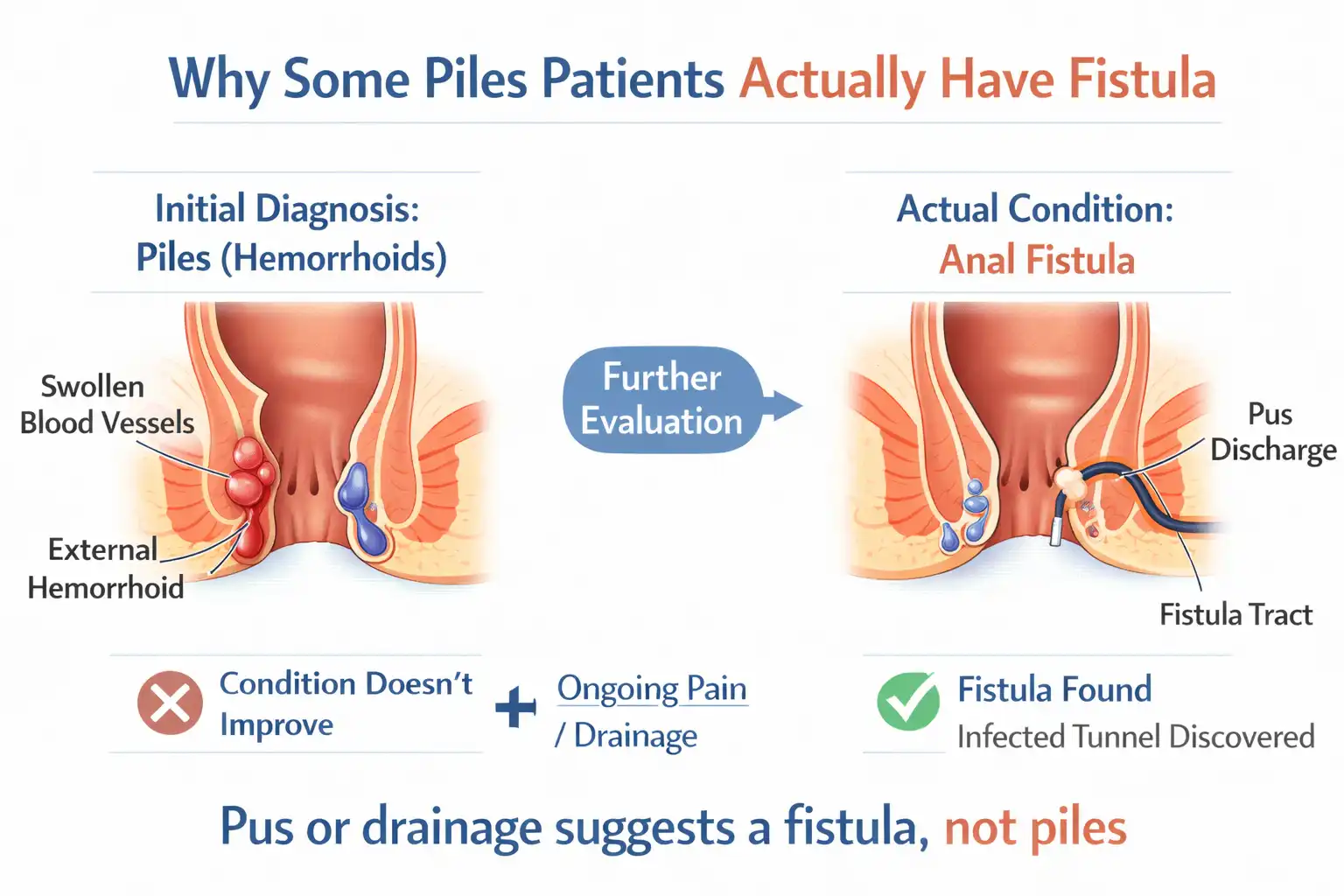
How Can a Piles Patient Actually Have a Fistula Without Knowing It?
A fistula can start very quietly. The initial event is often a small perianal abscess that either drains spontaneously or is opened and drained at a general clinic. The patient feels better, considers it resolved, and moves on. But internally, a small tract has formed between the anal canal and the skin. This tract produces intermittent discharge — sometimes pus, sometimes mucus — and the patient attributes it to “wet piles” or “leaky bawaseer.”
In my practice, I regularly see patients who have been using piles suppositories and creams for this exact situation. They get partial relief because the creams reduce inflammation temporarily. But the fistula is still there. For expert piles treatment solutions vs anal fistula clinic care, the difference in outcome is significant.
What Are the Key Differences Between Piles and Fistula That Patients Miss?
| Piles (What Patients Expect) | Fistula (What Is Actually There) |
|---|---|
| Bleeding, mainly bright red | Discharge — pus, mucus, sometimes blood |
| Lump at or inside the anus | Opening on skin near anus (external opening) |
| Related to bowel habits | Discharge continuous or intermittent, not related to motion |
| Responds partially to piles cream | Does NOT respond to piles cream |
| Single episode or flare | Recurs repeatedly in same location |
The most telling sign I look for is a small external opening on the skin near the anus — sometimes just a pinhole-sized spot that occasionally discharges. Patients often miss this because it is painless and small. But to a trained eye, it immediately signals a fistula. See how laser fistula treatment works for how fistula presents and is diagnosed.
Why Does Complex Fistula Surgery Become Necessary After Years of Misdiagnosis?
A simple low fistula — diagnosed early — can usually be treated in one straightforward procedure. But when a fistula is left for years, the tract extends, branches, and sometimes develops secondary openings. What was once a simple single-tract fistula becomes a complex, multi-tract fistula involving the sphincter muscle. These require staged procedures and careful planning to avoid damaging the sphincter.
I have operated on patients with fistulas that had been present for 5 to 7 years. By the time they came to me, the surgery was significantly more complex than it needed to be. The outcome was still good — but it took longer and required more procedures. In my opinion, this is completely avoidable with early diagnosis. See expert surgical consultation for how complex fistula cases are approached. Also see real patient outcomes at KPC for real outcomes.
What Does a Specialist at an Anal Fistula Clinic Do Differently Than a General Doctor?
A specialist who regularly treats fistulas knows exactly what to look for. During examination, they use a probe to identify the external opening, assess the tract direction using Goodsall’s rule, and determine the relationship of the tract to the sphincter muscle. This cannot be done casually — it requires specific knowledge, proper instruments, and experience with many fistula cases.
In some complex cases, I order an MRI fistulogram before surgery — this maps the tract in 3D so I know exactly what I am dealing with. General practitioners simply do not have the training or tools for this level of assessment. For modern hemorrhoid management resources alongside fistula care, see that resource. Also explore effective pain control approaches used at our clinic and laser treatment benefits for our minimally invasive fistula procedures.
If your piles treatment has been going on for more than 3 months without resolution, please consider getting a second opinion at a dedicated anal fistula clinic. The condition might not be piles at all. And the sooner that is discovered, the simpler and faster the real treatment will be.
🤔 Free Tool
Not Sure What Your Symptoms Mean?
Take our free 10-question symptom checker. Get an instant result — Piles, Fissure, Fistula, or Pilonidal Sinus — with treatment options and estimated cost.
▶ Check Your Symptoms FreeUnder 2 minutes · Free · Instant result · No login required
Book Your Consultation
Considering laser treatment? Let’s talk about your case.
WhatsApp me directly on 0333-2877351. OPD timings: Tuesday, Thursday, Saturday — 5:00 PM to 8:00 PM at Karachi Piles Clinic, in Hill Park General Hospital, Shaheed-e-Millat Road, Karachi. Consultation fee Rs. 2,000.
🔗 Related Articles
🔗 Related Articles