“Doctor, kal raat achanak ek gola aa gaya — bohat dard ho raha hai.” When a patient calls or messages with this description, my first thought is thrombosed external pile. This is one of the most acutely painful anorectal presentations — and it has a specific, effective treatment. Thrombosed piles treatment is time-sensitive: the earlier the intervention, the better the outcome.
What Is a Thrombosed Pile and Why Does It Cause Such Severe Pain?
A thrombosed external pile is an external haemorrhoid in which a blood clot has formed inside the dilated vein. The sudden clot formation — often triggered by straining, heavy lifting, or prolonged sitting — causes the haemorrhoidal tissue to become tense, swollen, and extremely tender. The overlying skin is stretched over the clot, and even mild pressure or sitting causes sharp pain.
Unlike internal haemorrhoids, which sit above the dentate line in the anaesthetic zone, thrombosed external piles sit below the dentate line where somatic pain fibres are present. This is why they are so painful. Thrombosed piles treatment that addresses the clot directly provides dramatic pain relief. For comprehensive piles care, thrombosed piles are a distinct emergency requiring specific management.
What Are the Treatment Options for Thrombosed Piles and Which Is Best?
| Treatment | When Used | Outcome |
|---|---|---|
| Incision and clot evacuation | Within 48–72 hours of onset | Dramatic, almost immediate pain relief |
| Conservative management | After 72 hours when clot begins to organise | Gradual resolution over 2–4 weeks |
| Formal excision of haemorrhoid | Recurrent thrombosis or large pile | Definitive — prevents recurrence |
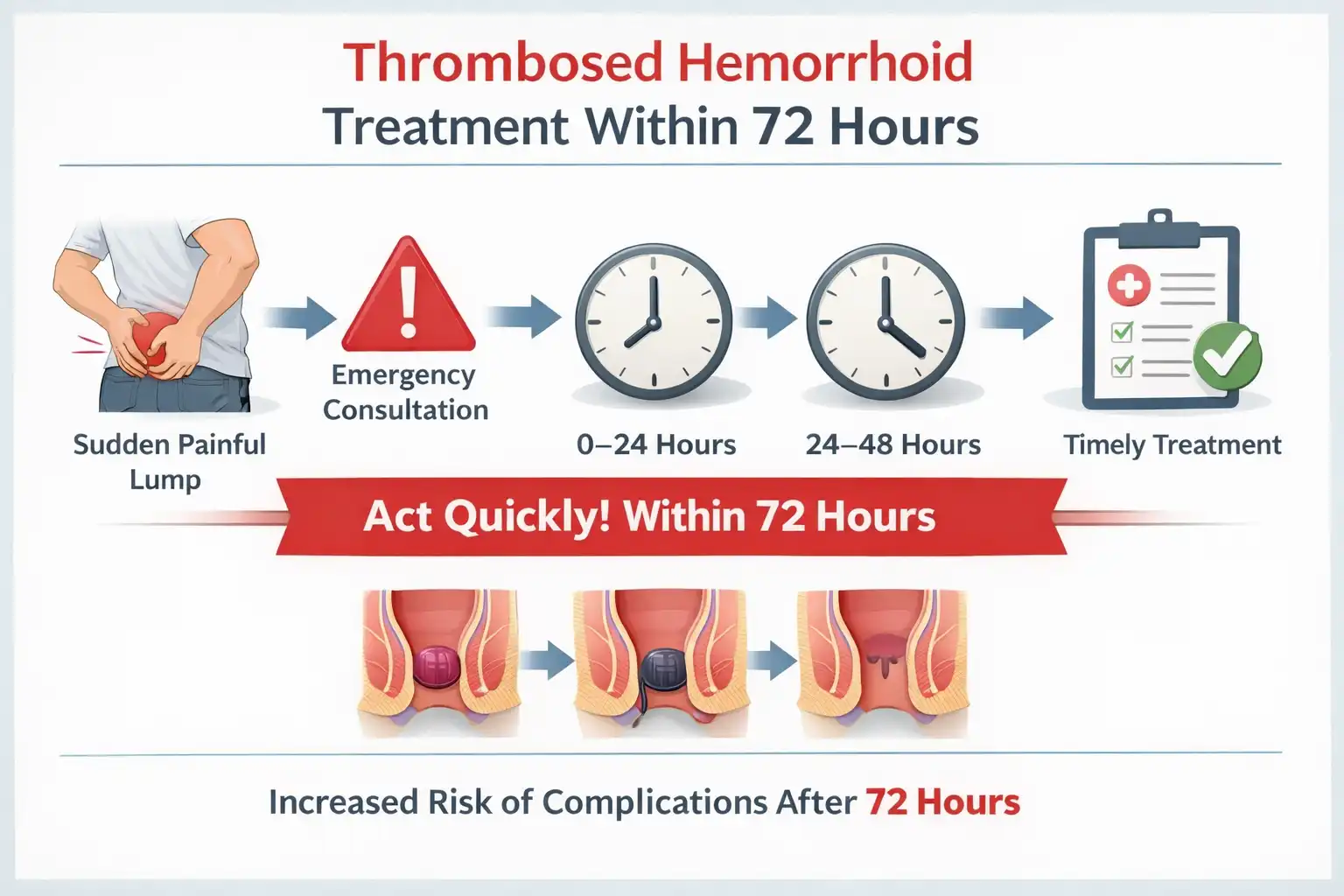
The 72-hour window is critical. Within the first three days of a thrombosed pile, a simple in-clinic incision under local anaesthesia evacuates the clot. The relief is almost instant — patients describe feeling the pain resolve within minutes of the procedure. After 72 hours, the clot begins to organise and harden, making evacuation less effective. At that point, conservative management — sitz baths, anti-inflammatories, stool softeners — is the main approach with resolution over 2 to 4 weeks. See fissure and emergency anal care and urgent anal treatment resources.
What Happens if Thrombosed Piles Are Left Untreated?
Without treatment, a thrombosed pile follows a predictable natural history. The pain peaks at 48 to 72 hours, then gradually diminishes over 2 to 4 weeks as the body reabsorbs the clot. Many resolve completely — but some leave behind a skin tag, and some progress to strangulation or ulceration if the skin overlying the clot breaks down.
The choice to treat or observe depends on timing and symptom severity. A patient who presents on day 5 with resolving pain is better managed conservatively. A patient who presents on day 2 with severe pain that prevents sitting or walking — this is the right candidate for immediate evacuation. See emergency anal surgery and piles consultation. Kya aapko ye dard 72 ghante se kam waqt se ho raha hai? Jaldi aayein.
A sudden painful lump near the anus is almost always a thrombosed pile — and it is very treatable within the right window. The 72-hour rule is the most important thing to know. Act within that window and the relief is fast and complete.
🤔 Free Tool
Not Sure What Your Symptoms Mean?
Take our free 10-question symptom checker. Get an instant result — Piles, Fissure, Fistula, or Pilonidal Sinus — with treatment options and estimated cost. For more on this, see dedicated pilonidal sinus laser service.
▶ Check Your Symptoms FreeUnder 2 minutes · Free · Instant result · No login required
Book Your Consultation
Considering laser treatment? Let’s talk about your case.
WhatsApp me directly on 0333-2877351. OPD timings: Tuesday, Thursday, Saturday — 5:00 PM to 8:00 PM at Karachi Piles Clinic, in Hill Park General Hospital, Shaheed-e-Millat Road, Karachi. Consultation fee Rs. 2,000.
🔗 Related Articles