“Doctor, kamzori bahut hai, chakkar bhi aata hai, aur pata chala haemoglobin 8 hai.” When a patient presents with anaemia, the cause is not always obvious. But when I ask about rectal symptoms and they confirm regular bleeding — often dismissed as minor — the diagnosis becomes clear. Chronic bleeding piles cure is the treatment that addresses both the anaemia and its source simultaneously.
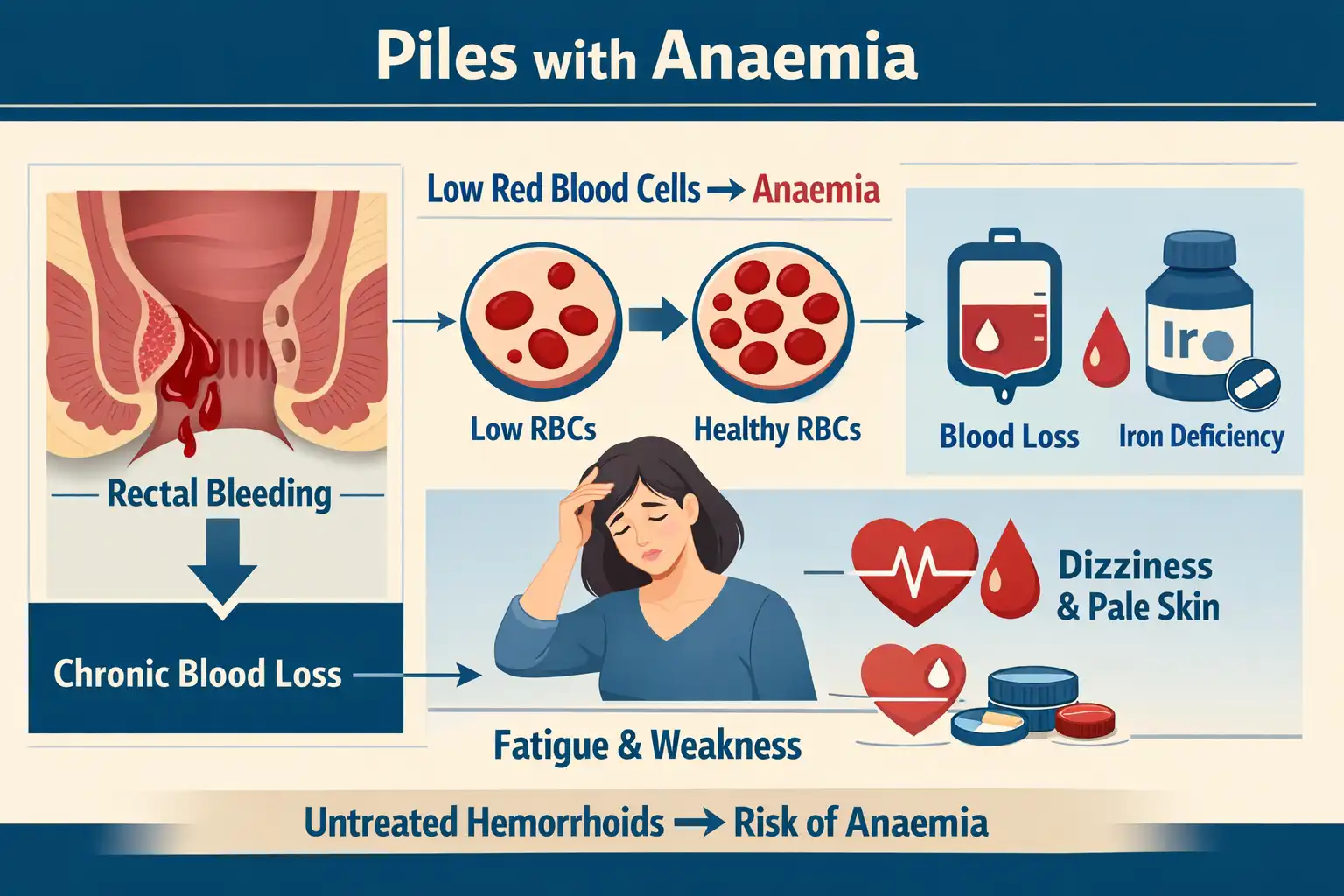
Can Piles Cause Anaemia and How Common Is This?
Yes — absolutely. Haemorrhoidal bleeding is one of the most common causes of iron-deficiency anaemia in adults in Pakistan, yet it is frequently missed because patients — and sometimes doctors — do not connect the rectal bleeding to the falling haemoglobin. The bleeding from piles often seems minor: a streak of blood, a few drops. But happening daily for months or years, the cumulative loss becomes substantial.
In my practice, I routinely find patients with haemoglobin between 7 and 9 g/dL who have been on iron supplementation for months without the source being addressed. Treating the anaemia without stopping the bleeding is like filling a bucket with a hole in the bottom. Chronic bleeding piles cure requires fixing the source — not just supplementing the loss. For comprehensive piles care, bleeding control is always the primary goal.
What Are the Symptoms of Anaemia Caused by Chronic Piles Bleeding?
| Symptom | Severity Level | When to Seek Urgent Care |
|---|---|---|
| Fatigue and weakness | Mild — very common | If worsening rapidly |
| Dizziness or lightheadedness | Moderate | If occurring on standing |
| Breathlessness on minimal exertion | Moderate–severe | Always needs assessment |
| Pale skin, pale conjunctivae | Moderate | Check haemoglobin urgently |
| Rapid heartbeat at rest | Severe | Emergency — urgent blood transfusion may be needed |
When haemoglobin drops below 7 g/dL, patients need urgent assessment for possible transfusion before any piles procedure can be safely performed. Above 8 to 9 g/dL with symptoms, iron replacement alongside piles treatment is the standard approach. See piles assessment booking and my detailed article on bleeding from the anus — diagnostic guide.
Worried about piles with weakness or anemia?
Describe your symptoms to Dr. Abdullah Iqbal’s team on WhatsApp and get guidance on whether you need a checkup. OPD: Tue, Thu & Sat — 5:00–8:00 PM, Shaheed-e-Millat Road, Karachi.
💬 WhatsApp the ClinicWhat Is the Most Effective Treatment to Stop Chronic Piles Bleeding?
The treatment depends on the grade. For Grade 1 chronic bleeding: flavonoids plus sclerotherapy achieves haemostasis in most patients within 4 to 6 weeks. For Grade 2: rubber band ligation is highly effective at stopping bleeding — success rate of 85 to 90 percent. For Grade 3 with significant chronic bleeding: laser haemorrhoidoplasty stops the bleeding definitively in most cases within 4 to 8 weeks of the procedure.
Alongside the procedure, I always prescribe: iron supplementation for documented anaemia, dietary fibre to prevent re-straining, and a follow-up haemoglobin check at 8 to 12 weeks to confirm the anaemia is correcting. The two-track approach — stop the bleeding, correct the anaemia — is the only complete treatment. See bawaseer ka ilaj and evidence-based piles therapy. Kya aapka khoon ki kami ka check hua tha? It should be part of every chronic bleeding piles assessment.
Anaemia from piles is completely preventable and reversible — but only when the bleeding source is treated, not just the anaemia itself. A chronic bleeding piles cure that addresses both simultaneously is the only complete solution.
🤔 Free Tool
Not Sure What Your Symptoms Mean?
Take our free 10-question symptom checker. Get an instant result — Piles, Fissure, Fistula, or Pilonidal Sinus — with treatment options and estimated cost. For more on this, see how I treat anal fistula with FiLaC and laser.
▶ Try the Free Symptom CheckerUnder 2 minutes · Free · Instant result · No login required
Book Your Consultation
Ready to book a consultation at Karachi Piles Clinic?
WhatsApp me directly on 0333-2877351. OPD timings: Tuesday, Thursday, Saturday — 5:00 PM to 8:00 PM at Karachi Piles Clinic, in Hill Park General Hospital, Shaheed-e-Millat Road, Karachi. Consultation fee Rs. 2,000.
🔗 Related Articles
🔗 Related Articles