“Doctor, sunna hai ke piles khud theek ho jaati hai — kya ye sach hai?” This question comes up regularly, and the answer is nuanced. Effective piles treatment options exist across a wide range, but the premise that piles simply heal on their own — for everyone, always — is not accurate. The truth depends heavily on the grade.
Can Piles Heal on Their Own Without Any Treatment?
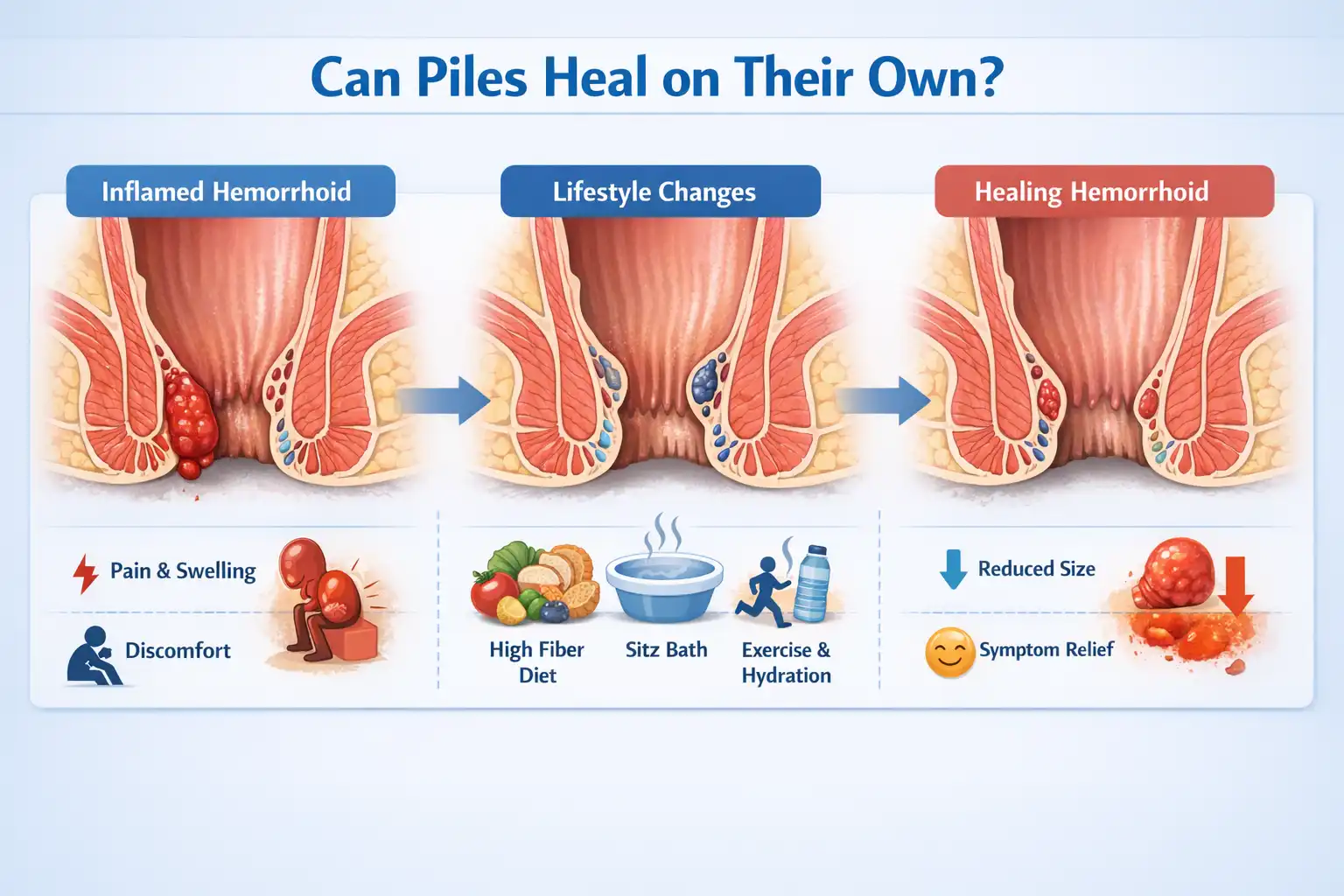
Grade 1 haemorrhoids — with intermittent minor bleeding and no prolapse — can sometimes improve or stabilise with lifestyle changes alone. High fibre, adequate hydration, avoiding straining: these can reduce the engorgement and bleeding of small internal haemorrhoids. In this specific scenario, piles can “heal” in the sense of becoming asymptomatic.
Grade 2, 3, and 4 do not heal on their own. The haemorrhoidal tissue has stretched, prolapsed, or permanently descended. No amount of dietary change reverses the anatomical change that has occurred. Symptoms may fluctuate — better some weeks, worse others — but the underlying condition does not resolve without intervention. Effective piles treatment options are what achieve that resolution. For comprehensive piles care, the answer to “will it go away” is always grade-dependent.
How Likely Is It for Piles to Self-Resolve Based on Grade?
| Grade | Chance of Self-Resolution | Recommended Action |
|---|---|---|
| Grade 1 | Possible with diet and lifestyle | 4-6 week trial of conservative measures |
| Grade 2 | Low — prolapse does not self-resolve | Seek specialist within 4 weeks if no improvement |
| Grade 3 | Very unlikely | Specialist assessment and procedure needed |
| Grade 4 | Does not self-resolve | Definitive surgical treatment required |
The table tells the story. Hope for self-resolution is only reasonable at Grade 1 — and even there, it requires active lifestyle intervention, not passive waiting. See piles specialist visit and bawaseer ka ilaj.
What Happens Physically When Grade 2 or 3 Piles Are Left Without Treatment?
The supporting ligaments — Parks’ ligaments — that hold haemorrhoidal cushions in place stretch progressively with repeated prolapse and straining. Once stretched, they do not spring back. Each episode of prolapse stretches them further. Over months and years, Grade 2 progresses to Grade 3, and Grade 3 prolapse becomes permanent — Grade 4.
This is why the question “will it go away” — when asked about Grade 3 — always gets the same answer from me: no. But the better question is: how quickly can we resolve it with the right treatment? And for Grade 3, the answer is often just weeks. See evidence-based piles therapy and hemorrhoid treatment resources. Kya aap Grade 2 ya 3 hain aur wait kar rahe hain? Stop waiting — come in.
What Are the Most Effective Piles Treatment Options Available Today?
From least to most invasive: lifestyle modification for Grade 1, sclerotherapy for Grade 1 bleeding, rubber band ligation for Grade 2, laser haemorrhoidoplasty for Grade 2 to 3, and open haemorrhoidectomy or complex laser for Grade 4. Each has its place. The most effective option is always the one matched to your specific grade — not the most advertised or most expensive one.
See how to know if your symptoms are piles for self-assessment before a consultation.
Piles sometimes self-resolve at Grade 1 with the right lifestyle. They do not at Grade 2 and above. The most effective treatment is always grade-matched clinical care. The longer you wait for a Grade 2 or 3 to “go away,” the more it progresses toward something that needs a more significant intervention.
🤔 Free Tool
Not Sure What Your Symptoms Mean?
Take our free 10-question symptom checker. Get an instant result — Piles, Fissure, Fistula, or Pilonidal Sinus — with treatment options and estimated cost.
▶ Free 2-Minute Symptom QuizUnder 2 minutes · Free · Instant result · No login required
Book Your Consultation
Got questions for Pakistan’s first laser proctologist?
WhatsApp me directly on 0333-2877351. OPD timings: Tuesday, Thursday, Saturday — 5:00 PM to 8:00 PM at Karachi Piles Clinic, in Hill Park General Hospital, Shaheed-e-Millat Road, Karachi. Consultation fee Rs. 2,000.
🔗 Related Articles
🔗 Related Articles