“Doctor, meri ammi kehti hain ke kachchi haldi aur doodh peeney se bawaseer theek ho jaati hai.” I hear things like this every week. Safe medical treatment for piles is entirely possible — but desi totkay are not part of it. Let me be clear about what traditional remedies do and do not do, so patients can make informed choices rather than delaying proper treatment for months.
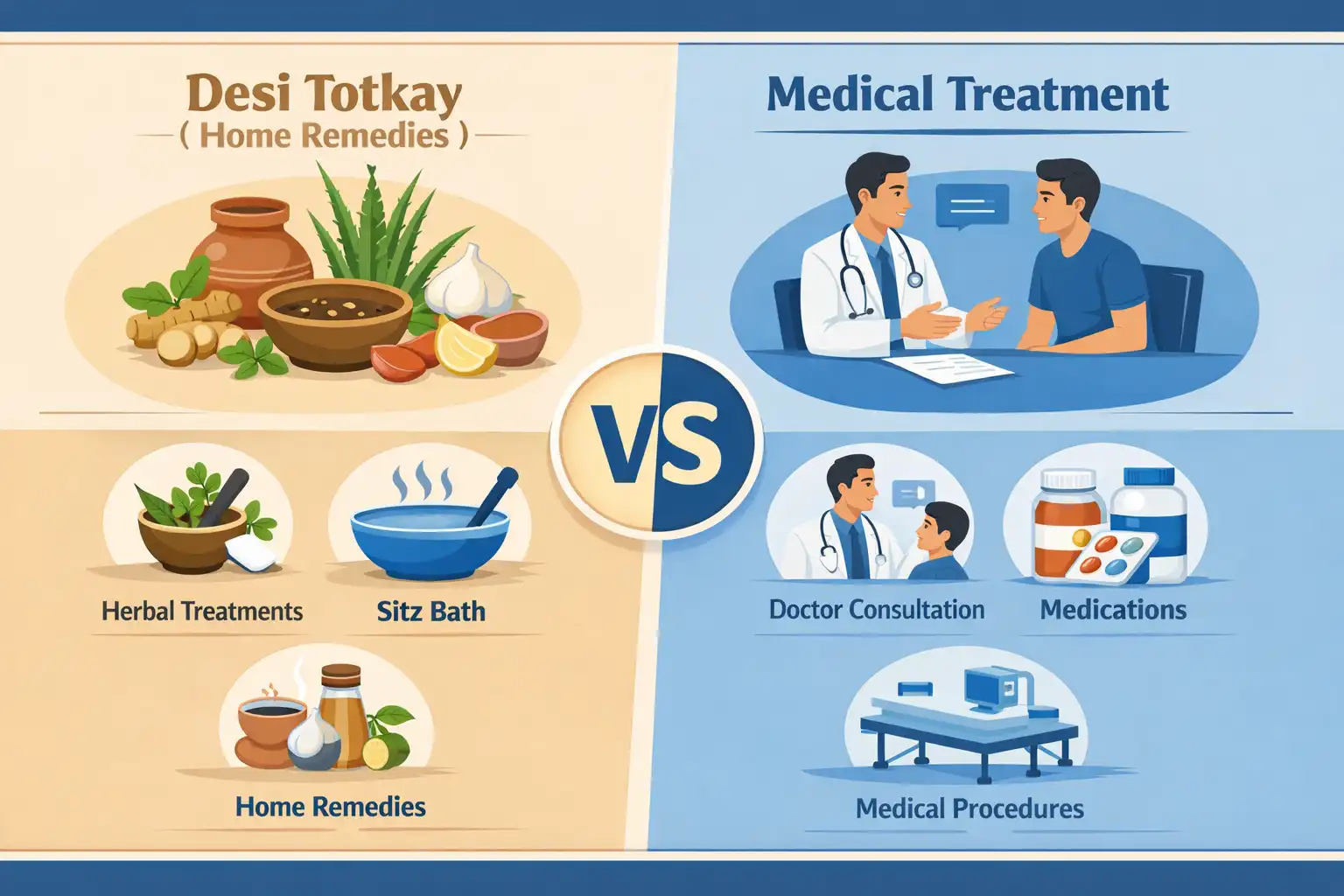
Are Desi Totkay for Piles Safe and Do Any of Them Actually Work?
Some traditional remedies are harmless, some are completely ineffective, and a few are genuinely harmful. The distinction matters. Ispaghol husk dissolved in water — widely used in Pakistan — is medically sound as a stool softener and is something I recommend. Warm water sitz baths are also legitimate. These are not “desi totkay” in the dismissive sense — they are dietary and hygiene measures with real clinical benefit.
What does not work: applying raw turmeric paste directly to the anus (can cause chemical irritation), garlic suppositories (intensely irritating to anal mucosa — I have treated patients who burned their anal canal with this), and drinking various herbal concoctions that claim to “dissolve” haemorrhoids. These are not safe medical treatment for piles. For comprehensive piles care, the evidence base is clear and should guide all treatment decisions.
Which Traditional Remedies Are Safe and Which Are Harmful for Piles?
| Traditional Remedy | Safety | Effectiveness |
|---|---|---|
| Ispaghol (psyllium husk) + water | Safe — recommended | Yes — softens stool |
| Warm sitz baths | Safe — recommended | Yes — relieves spasm |
| Coconut oil application | Generally safe | Mild moisturising only |
| Raw garlic application | Harmful — avoid | No benefit, causes burns |
| Raw turmeric paste application | Irritating — avoid | No benefit |
| Herbal teas claiming to cure piles | Mostly harmless | No clinical evidence |
| Sitting in mustard oil | Not harmful | No evidence |
The safe traditional measures are the ones that overlap with evidence-based medicine: fibre, hydration, warm water. The unsafe ones are anything applied directly to the anal area that has not been validated clinically. See bawaseer ka ilaj for culturally informed guidance on safe home management. Also see evidence-based piles therapy.
Why Do Patients in Karachi Prefer Totkay Over Medical Treatment?
The reasons are very understandable: embarrassment about the location of the problem, fear of examination, concern about cost, and genuine trust in family knowledge passed through generations. I do not dismiss these factors. They are real, and they influence health-seeking behaviour significantly in Pakistani culture.
What I try to explain is that the delay caused by six months of ineffective totkay allows Grade 2 to become Grade 3, and Grade 3 to become Grade 4. The thing that makes the eventual treatment more expensive and more invasive is precisely the delay during which totkay were being tried. Kya aap ne bhi pehle ghar mein try kiya aur kaam nahi aaya? This is the right time to come in. See in-clinic piles assessment and hemorrhoid treatment resources.
What Is the Safest and Most Effective Medical Treatment Pathway for Piles?
The evidence-based pathway: correct diagnosis and grading first, lifestyle modification — fibre and hydration — always. Then grade-matched treatment: sclerotherapy or banding for Grade 1 and 2, laser haemorrhoidoplasty for Grade 3, open or complex laser for Grade 4. Post-procedure follow-up and continued lifestyle maintenance for long-term results.
This is not complicated or frightening. It is systematic, tailored, and evidence-backed. It achieves permanent results where totkay cannot. See piles or another anal condition for self-assessment before your consultation.
Desi totkay come from a place of genuine care — from families trying to help. But for piles beyond Grade 1, they are not enough. Safe medical treatment for piles is accessible, affordable, and far more effective. Make the step when the totkay have had their chance.
🤔 Free Tool
Not Sure What Your Symptoms Mean?
Take our free 10-question symptom checker. Get an instant result — Piles, Fissure, Fistula, or Pilonidal Sinus — with treatment options and estimated cost.
▶ Check Your Symptoms FreeUnder 2 minutes · Free · Instant result · No login required
Book Your Consultation
Ready to book a consultation at Karachi Piles Clinic?
WhatsApp me directly on 0333-2877351. OPD timings: Tuesday, Thursday, Saturday — 5:00 PM to 8:00 PM at Karachi Piles Clinic, in Hill Park General Hospital, Shaheed-e-Millat Road, Karachi. Consultation fee Rs. 2,000.
🔗 Related Articles
🔗 Related Articles