“Doctor, mujhe piles hai — aur mujhe darne ki zaroorat nahi thi na?” This from a 34-year-old male patient who had avoided coming in for over a year. Best piles doctor in Karachi is a search that many men make only when things have become bad enough that they cannot ignore it anymore. Choosing the right surgeon from the start changes everything — not just the procedure itself, but how clearly you understand your condition, how confident you feel in the plan, and how well you recover afterwards. This article focuses on how to evaluate the surgeon as an individual practitioner — their credentials, experience, communication, and clinical approach. For evaluating the clinic facility separately, see how to choose a piles clinic in Karachi.
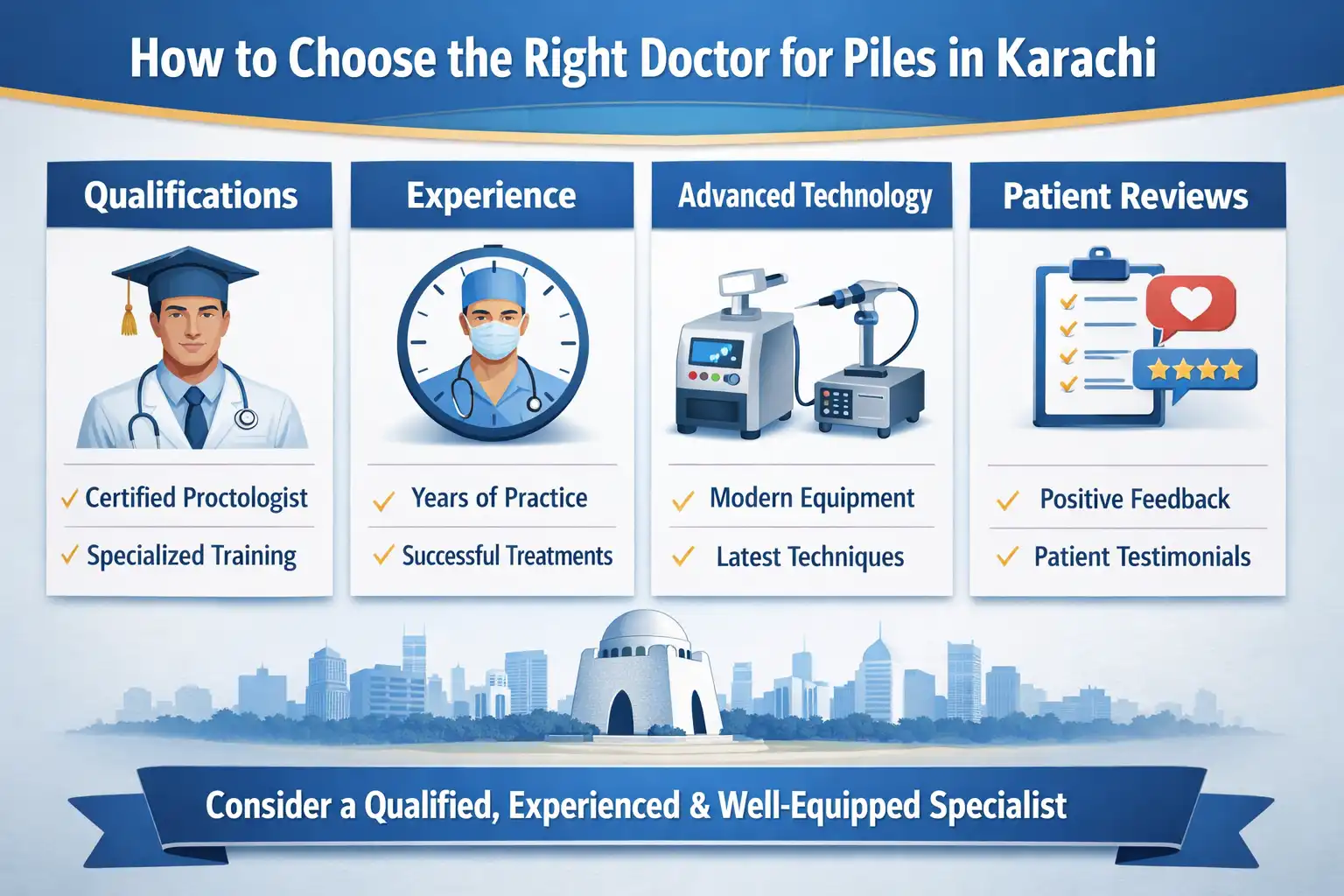
What Credentials Should a Piles Surgeon in Karachi Actually Have?
The minimum credentials for a piles surgeon in Pakistan are MBBS plus FCPS in General Surgery from the College of Physicians and Surgeons Pakistan (CPSP). My own credentials are MBBS from Liaquat University of Medical and Health Sciences (LUMHS) 2012, FCPS Surgery from CPSP 2018, and PMDC registration #63108-S. The PMDC number is verifiable directly on the Pakistan Medical and Dental Council website — anyone claiming to be a surgeon in Pakistan must hold a valid PMDC registration with appropriate qualification suffix. If a doctor will not give you their PMDC number on request, that itself is informative.
Beyond baseline FCPS, look for additional subspecialty exposure in colorectal or proctology procedures. Laser proctology in particular requires specific training that is not part of standard surgical residency in Pakistan. A surgeon who claims to perform laser hemorrhoidopexy should be able to explain where they received that training, how many cases they have done, and what their patient outcomes look like. I am happy to share these details with patients before they book — and any genuine specialist should be.
How to Read a Doctor’s Surgical Experience — Volume, Focus, and Outcomes
Surgical competence in any procedure correlates strongly with case volume. A general surgeon who performs 3 or 4 hemorrhoid procedures per year cannot match the technical refinement of a surgeon who performs them weekly. In my own practice at Karachi Piles Clinic, anorectal procedures are the entire focus — I have performed more than 5,000 laser proctology procedures across hemorrhoids, fistulas, fissures, and pilonidal sinus disease across 13+ years. That focused volume is what allows me to handle the difficult cases — the recurrences, the unusual presentations, the patients other clinics could not help.
When evaluating a doctor, ask directly: “How many of these procedures do you perform per month?” A specialist will give you a confident number. A generalist will deflect or generalise. Both responses are useful information. Also ask about their case mix — a doctor who treats only Grade 2 piles and refers Grade 4 cases away has a different practice depth than one who handles all grades and complications themselves.
| What to Ask | High-Volume Specialist Answer | Generalist Red Flag |
|---|---|---|
| Cases per month? | “I do roughly 30-50 piles procedures monthly” | “A few here and there” |
| Most difficult case recently? | Detailed clinical story with reasoning | Generic answer or deflection |
| Recurrence rate? | Concrete percentage with caveats | “Recurrence does not happen with my technique” |
| What if I have Grade 4 piles? | Confident management plan | “We refer those out” |
Worried about finding the right piles doctor?
Describe your symptoms to Dr. Abdullah Iqbal’s team on WhatsApp and get guidance on whether you need a checkup. OPD: Tue, Thu & Sat — 5:00–8:00 PM, Shaheed-e-Millat Road, Karachi.
💬 WhatsApp the ClinicThe Communication Test — How a Good Surgeon Explains Your Condition
How a doctor communicates during the first 15 minutes of a consultation tells you almost everything you need to know about whether they are the right surgeon for you. A good piles doctor will take a full history without rushing, explain what grade your piles are and why that matters, discuss all treatment options including the ones they do not personally perform, give honest expected outcomes including potential complications, and answer your questions in language you understand — without medical jargon used to confuse rather than clarify.
What a problematic consultation looks like: the doctor talks more than they listen, they recommend a procedure before fully examining you, they avoid discussing complications or recurrence rates, they pressure you to book on the same day. These patterns indicate a practice optimised for procedure volume rather than patient outcomes. The way I approach my own consultations at Hill Park General Hospital is the opposite — examination first, grading first, options discussed openly, and the patient leaves with a written plan they can think about before booking anything.
Five Questions to Ask the Doctor in Your First Consultation
These five questions will quickly reveal whether you are with the right surgeon:
- “What grade are my piles, and what does that mean for the right treatment?”
- “If you perform this procedure on me, who manages my follow-up — you personally or another doctor in the clinic?”
- “What is your recurrence rate for this specific procedure, and how do you handle recurrence if it happens?”
- “Can you walk me through the full cost — tests, anesthesia, follow-ups, and possible additional procedures?”
- “If complications develop after surgery, what is the protocol — who do I contact and what is the response time?”
I personally answer all five in every initial consultation. If a surgeon hesitates on any of them or cannot give you a clear answer, that is significant information about how they will manage your care after the procedure too. For what a properly structured consultation looks like start to finish, see what happens during a piles consultation in Karachi.
Red Flags in How a Doctor Examines, Diagnoses, and Recommends
Some warning signs in a piles consultation are subtle, others are obvious. The serious ones: recommending surgery without performing a proctoscopy or formal grading, quoting a fixed price before examining you, dismissing your symptoms or making you feel embarrassed for asking questions, promising zero possibility of recurrence (no honest surgeon claims this — every piles procedure carries some recurrence risk that should be discussed openly), or pushing the most expensive procedure when a less invasive option would work for your grade.
A diagnosis-first, treatment-second approach is the hallmark of an organised surgical practice. A doctor who examines properly, grades accurately, and explains your options before pricing — that is who you want operating on you. This is the standard I apply in my own clinic, and the standard I would apply if I were the patient choosing a surgeon.
Finding the best piles doctor in Karachi is not about reputation alone — it is about matching the surgeon’s credentials, communication, and clinical approach to your specific case. Use the checklist above. Ask the five questions. Watch for the red flags. The right surgeon for your case exists — finding them is a matter of knowing what to look for, not who shouts loudest.
Book Your Consultation
Ready to book a consultation at Karachi Piles Clinic?
WhatsApp me directly on 0333-2877351. OPD timings: Tuesday, Thursday, Saturday — 5:00 PM to 8:00 PM at Karachi Piles Clinic, in Hill Park General Hospital, Shaheed-e-Millat Road, Karachi. Consultation fee Rs. 2,000.
Outcome Data — The Numbers to Ask Any Piles Surgeon For
A credible piles doctor tracks their results and will show them to you. Dr. Abdullah Iqbal shares the same figures with every prospective patient before they commit:
| Piles Grade | 12-Month Success | 3-Year Recurrence |
|---|---|---|
| Grade 2 | 92–95% | 8–10% |
| Grade 3 | 88–92% | 10–15% |
| Grade 4 (selected cases only) | 80–85% | 15–20% |
Not every Grade 4 case is right for laser — an honest surgeon says so upfront and recommends open haemorrhoidectomy where it would serve you better. Whichever doctor you shortlist, ask for written outcome data: a surgeon who tracks their work seriously can always provide it.
Travel Time to the Clinic From Major Karachi Areas
“Near me” matters less than “reachable without compromise.” Karachi Piles Clinic operates at Hill Park General Hospital on Shaheed-e-Millat Road — central enough that most of the city reaches it within half an hour:
| Area | Typical Travel Time |
|---|---|
| Clifton / Saddar / Garden | 10–15 minutes |
| PECHS / Bahadurabad / Tariq Road | 10–15 minutes |
| DHA (Phase 1–8) | 15–25 minutes |
| Gulshan-e-Iqbal / Gulistan-e-Jauhar | 15–25 minutes |
| North Nazimabad / Federal B Area | 20–30 minutes |
| Korangi / Landhi / Malir | 25–40 minutes |
| Bahria Town Karachi | 45–60 minutes |
OPD runs Tuesday, Thursday and Saturday, 5:00–8:00 PM — evening hours chosen deliberately so working patients can attend without losing a workday. With same-day discharge, many office workers schedule surgery on a Thursday and are back at a desk by Monday.
What Happens at the First Consultation
Most patients arrive nervous; knowing the sequence removes most of the anxiety:
- Brief history — your symptoms, their duration, and what you have already tried
- External examination — non-invasive, no preparation required, full privacy
- Internal examination if indicated — proctoscope-based, 1–2 minutes, mildly uncomfortable but not painful
- Grading and diagnosis — a clinical grade (1–4) with a plain explanation of what it means
- All realistic treatment options — including non-surgical ones where appropriate
- A written, all-inclusive quote if surgery is indicated
- Booking — scheduled around your work commitments
The full visit takes 20–30 minutes. The consultation fee is Rs. 2,000, charged separately from any future procedure cost.
Common Questions From Patients Choosing a Piles Doctor
Do I need a referral to see a piles specialist?
No. You can book directly — most Pakistani patients see a proctologist without a GP referral. If you plan to claim on private insurance, check whether your insurer prefers a referral letter; the clinic can guide you on this during the consultation.
What if I am embarrassed to discuss piles symptoms?
Almost every patient says afterwards that they should have come months earlier — embarrassment delayed them. Examination is brief, professional and entirely confidential, and a dedicated piles clinic sees these conditions every working day. Whatever you are experiencing, it has been seen before.
Are evening appointments really available?
Yes — Tuesday, Thursday and Saturday, 5:00 PM to 8:00 PM, specifically so working professionals do not have to miss half a day at the office.
Can I have a WhatsApp video consultation before coming in person?
For patients outside Karachi, yes — initial WhatsApp video assessments cover reports and clinical history before you travel. Within Karachi, an in-person examination is preferred because piles cannot be properly graded over video.
Will I need follow-up after laser piles surgery?
Yes. Structured follow-up at one week, one month and three months is how recurrence is kept low — treat a doctor who offers no post-operative schedule as a red flag.
🔗 Related Articles