“Doctor, kya family physician ya GP bhi piles ka ilaj kar sakta hai?” The short answer is yes — for mild Grade 1 cases with conservative management. But for anything requiring a procedure, the answer changes. A piles specialist doctor is not just a general surgeon who sees piles occasionally — it is someone with focused anorectal training whose practice is built around these conditions.
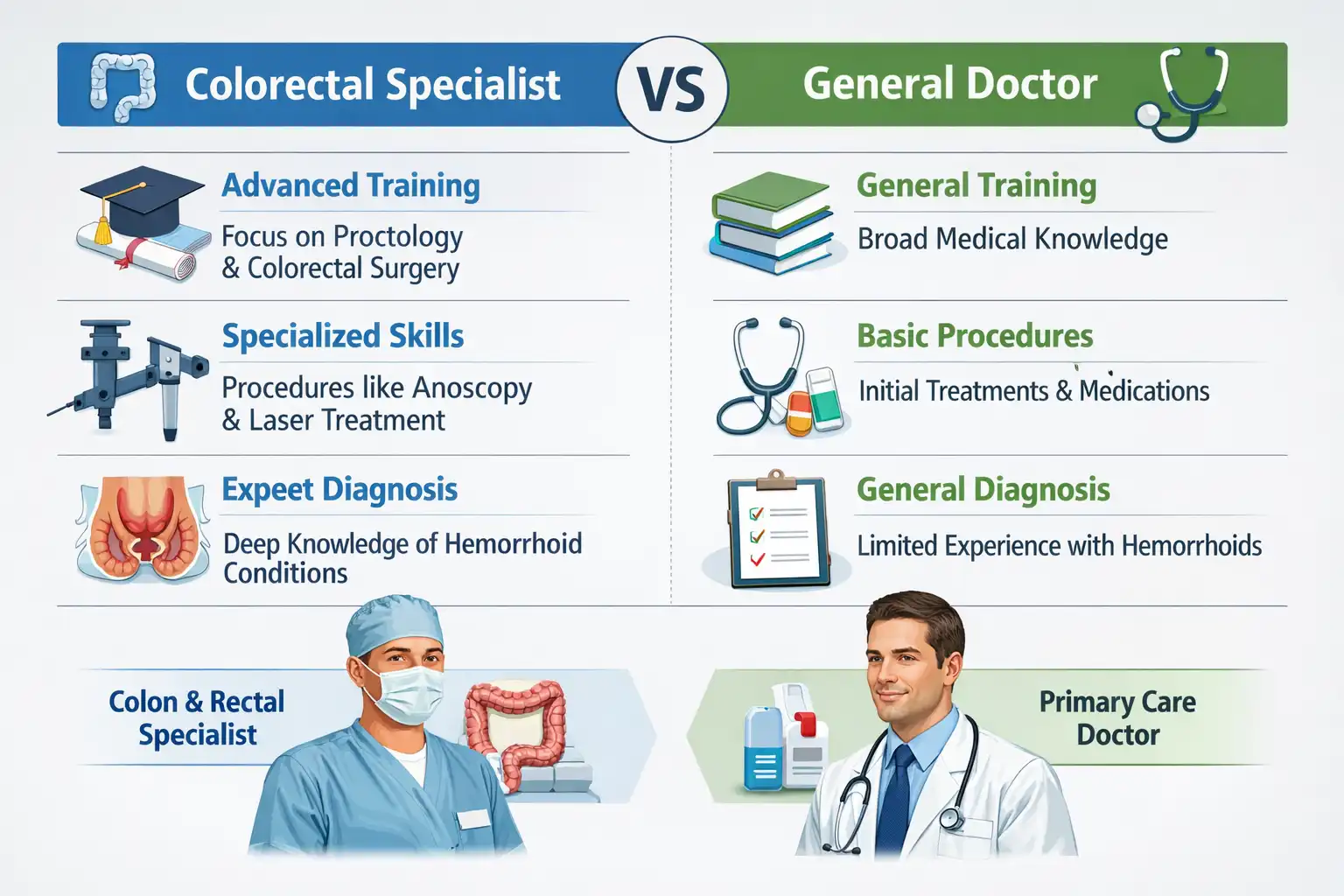
What Makes a Piles Specialist Doctor Different From a General Physician?
The difference is depth of training and volume of cases. A general physician can prescribe flavonoids and dietary advice for Grade 1 piles. But they typically do not perform proctoscopy, do not grade piles formally, do not perform rubber band ligation or laser procedures, and cannot diagnose associated conditions like fistulas or fissures with precision. A piles specialist doctor does all of these routinely.
In Pakistan, the relevant postgraduate qualification for surgical specialists is FCPS (Surgery) from CPSP, or MS (Surgery). A proctologist or colorectal surgeon with this qualification plus dedicated anorectal experience is what patients with Grade 2 and above should be seeing. For laser piles treatment information, the right level of specialist makes a measurable difference.
What Specific Skills Does a Piles Specialist Have That a General Doctor Does Not?
| Skill | General Physician | Piles Specialist Doctor |
|---|---|---|
| Proctoscopy and grading | Usually not performed | Routine part of every assessment |
| Rubber band ligation | Not performed | Standard in-clinic procedure |
| Laser haemorrhoidoplasty | Not performed | Day-care surgical procedure |
| Fistula diagnosis | Often missed | Routinely assessed and classified |
| Complex anorectal surgery | Not applicable | Full surgical capability |
These are not small differences. Fistula missed by a GP for two years versus diagnosed by a specialist in 5 minutes — that is a significant outcome gap. See about Dr. Abdullah Iqbal and evidence-based piles therapy.
When Should You Specifically Insist on Seeing a Piles Specialist Instead of a GP?
You should see a piles specialist immediately in these situations: rectal bleeding that has continued for more than 2 weeks without clear explanation, any visible or palpable lump at or near the anus, suspected Grade 2 or higher piles based on symptoms, piles treatment at GP level that has not improved after 4 to 6 weeks, and any discharge, pain, or swelling near the anus that does not fit the typical piles picture.
Also — anyone over 40 with rectal bleeding should see a specialist who can perform proctoscopy or colonoscopy to rule out other causes. This is not an overreaction — it is appropriate precaution. See specialist consultation and bawaseer ka ilaj. Kya aap ne pehle GP se mila tha aur fark nahi pada? Is this the stage you are at now?
What Qualifications Should a Genuine Piles Specialist Doctor Have?
In Pakistan, the appropriate qualifications for a piles specialist include MBBS (basic medical degree) plus FCPS in Surgery (Fellow of the College of Physicians and Surgeons Pakistan). Some specialists also hold MS Surgery or FRCS (UK/Ireland). Additionally, specific training or experience in anorectal and proctology procedures is important — not all surgeons subspecialise here.
A specialist who describes themselves as a proctologist or anorectal surgeon and has the relevant surgical qualification is the appropriate person for piles treatment beyond Grade 1.
Also seek a specialist if you are in a high-risk group: over 40 with rectal bleeding (to rule out polyps or cancer), pregnant (to ensure safe management), diabetic (wound healing concerns with any procedure), or on blood thinners (affects treatment choice significantly).
A piles specialist doctor does not just know more — they do more, see more, and diagnose more accurately. For anything beyond the simplest Grade 1 management, specialist care gives you a fundamentally better outcome.
Book Your Consultation
Want to discuss your symptoms with Dr. Abdullah Iqbal?
WhatsApp me directly on 0333-2877351. OPD timings: Tuesday, Thursday, Saturday — 5:00 PM to 8:00 PM at Karachi Piles Clinic, in Hill Park General Hospital, Shaheed-e-Millat Road, Karachi. Consultation fee Rs. 2,000.
🔗 Related Articles
🔗 Related Articles