“Doctor, poora din baithke kaam karta hun — aur shayad isi wajah se bawaseer hui hai.” This is one of the most accurate self-diagnoses I hear. Sitting jobs — the reality of millions of working people in Karachi — are a well-established risk factor for piles. Piles treatment for office workers has to address both the condition and the occupational pattern that worsens it.
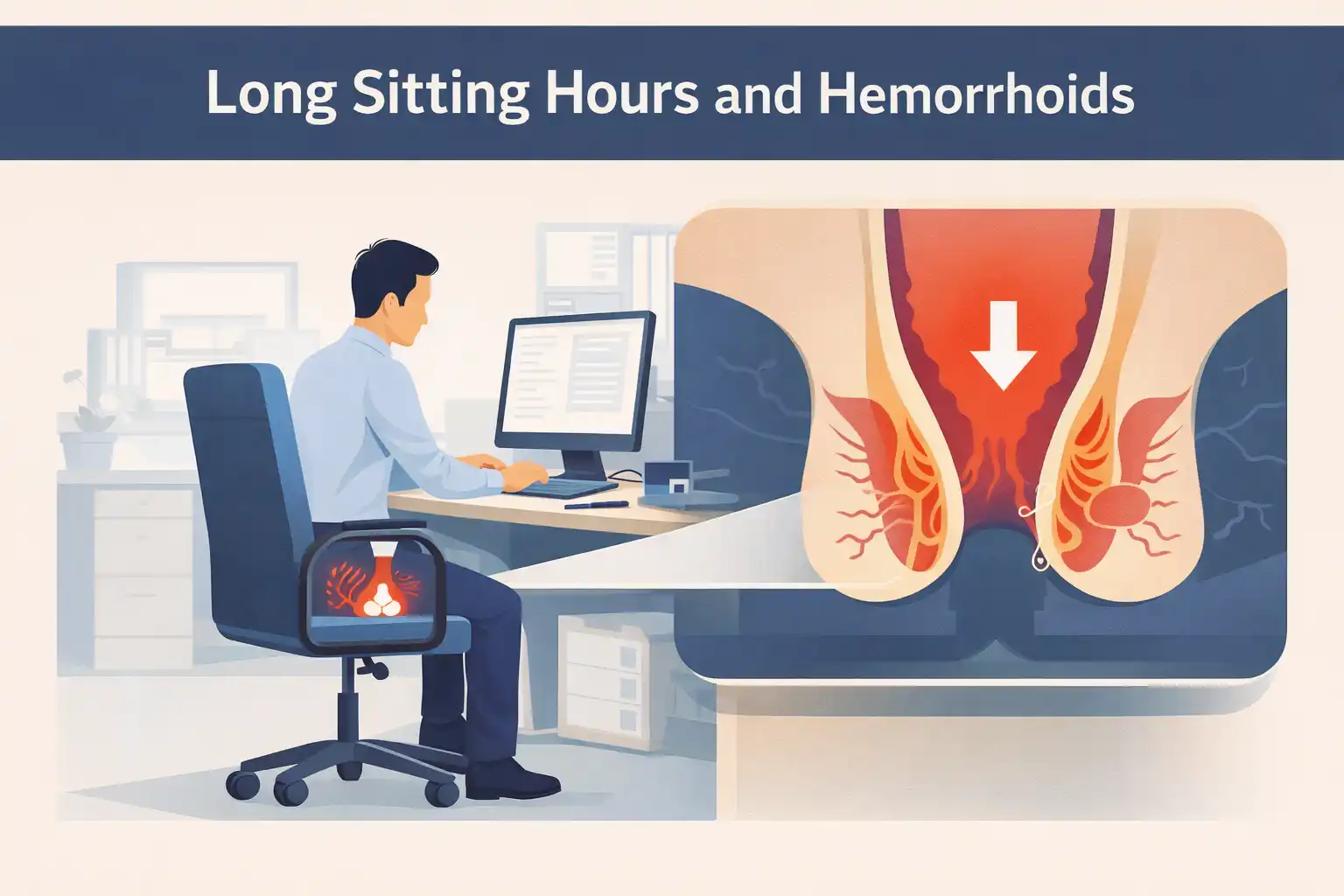
Why Do Sitting Jobs in Karachi Cause or Worsen Piles?
Prolonged sitting increases pressure on the pelvic floor and the anorectal venous system. The haemorrhoidal cushions sit in a position of constant compression when you are seated — especially on hard chairs or in a forward-leaning posture. Over 8 to 10 hours of desk work daily, with limited movement, this sustained compression impairs venous drainage from the haemorrhoidal plexus and contributes to engorgement and swelling.
Combined with the other realities of Karachi office life — high-spice diet, insufficient water intake in air-conditioned environments, low fibre, and long daily commutes adding to total sitting time — the recipe for piles is complete. Piles treatment for office workers that ignores these occupational factors will produce results that do not last. For comprehensive piles care, occupational history is always part of the consultation.
How Does Prolonged Sitting at Work Compare to Other Piles Risk Factors?
| Risk Factor | Mechanism | Modifiable? |
|---|---|---|
| Prolonged sitting | Sustained pelvic venous compression | Yes — movement breaks, cushion |
| Low fibre diet | Constipation, straining | Yes — dietary change |
| Insufficient hydration | Hard stool, straining | Yes — easy to fix |
| Long commutes | Additional sitting time | Partially — cushion, posture |
| Age-related tissue laxity | Weakened supporting ligaments | No — but progression can be slowed |
Almost all the modifiable risk factors for office workers are addressable with simple changes. The problem is consistency — knowing what to do and actually doing it through a busy workday are different things. See piles specialist visit for occupational risk assessment. Also see bawaseer ka ilaj.
What Specific Office Habits Can Reduce Piles Symptoms While Treating the Condition?
I recommend to all my office-working patients: stand up and walk for 3 to 5 minutes every 45 to 60 minutes during the workday — even within the office. Use a cushioned seat or a donut cushion during active flare-ups. Keep a water bottle at your desk and drink at least 6 to 8 glasses during work hours. Take your lunch break away from your desk. Avoid eating at your desk while seated continuously for hours.
These are practical, achievable changes that reduce the occupational contribution to piles. Combined with proper medical treatment, they significantly extend the time before recurrence. Kya aap ka workplace in changes allow karta hai? Most do — because standing and short walking breaks also improve productivity. See is your symptom actually piles and evidence-based piles therapy.
What Treatment Options Work Best for Piles in Karachi Office Workers?
For office workers, the key treatment consideration is recovery time. Laser haemorrhoidoplasty for Grade 3 offers 3 to 5 days off work — achievable over a weekend plus 2 to 3 working days. Rubber band ligation for Grade 2 requires no procedure room recovery — patients can often return to the office the same or next day. Sclerotherapy for Grade 1 requires no time off at all.
Planning treatment around a weekend, or scheduling it before a short leave period, makes it practical for working professionals. I regularly help patients time their procedures for minimal disruption. See hemorrhoid treatment resources for more on treatment selection for working professionals.
Sitting jobs and piles are closely connected — but this is a connection that can be managed. Treat the condition with the right procedure, modify the occupational habits that worsened it, and the outcome is lasting relief without significant disruption to your working life.
🤔 Free Tool
Not Sure What Your Symptoms Mean?
Take our free 10-question symptom checker. Get an instant result — Piles, Fissure, Fistula, or Pilonidal Sinus — with treatment options and estimated cost.
▶ Free 2-Minute Symptom QuizUnder 2 minutes · Free · Instant result · No login required
Book Your Consultation
Want to discuss your symptoms with Dr. Abdullah Iqbal?
WhatsApp me directly on 0333-2877351. OPD timings: Tuesday, Thursday, Saturday — 5:00 PM to 8:00 PM at Karachi Piles Clinic, in Hill Park General Hospital, Shaheed-e-Millat Road, Karachi. Consultation fee Rs. 2,000.
🔗 Related Articles
🔗 Related Articles