“Doctor, delivery ke ek mahine baad bhi bawaseer ki takleef hai — kya ye normal hai?” This is one of the questions I hear most from new mothers. Postpartum piles treatment is a genuinely common need — childbirth is one of the most acute triggers for haemorrhoid development or worsening, and many women do not know when to seek help afterward.
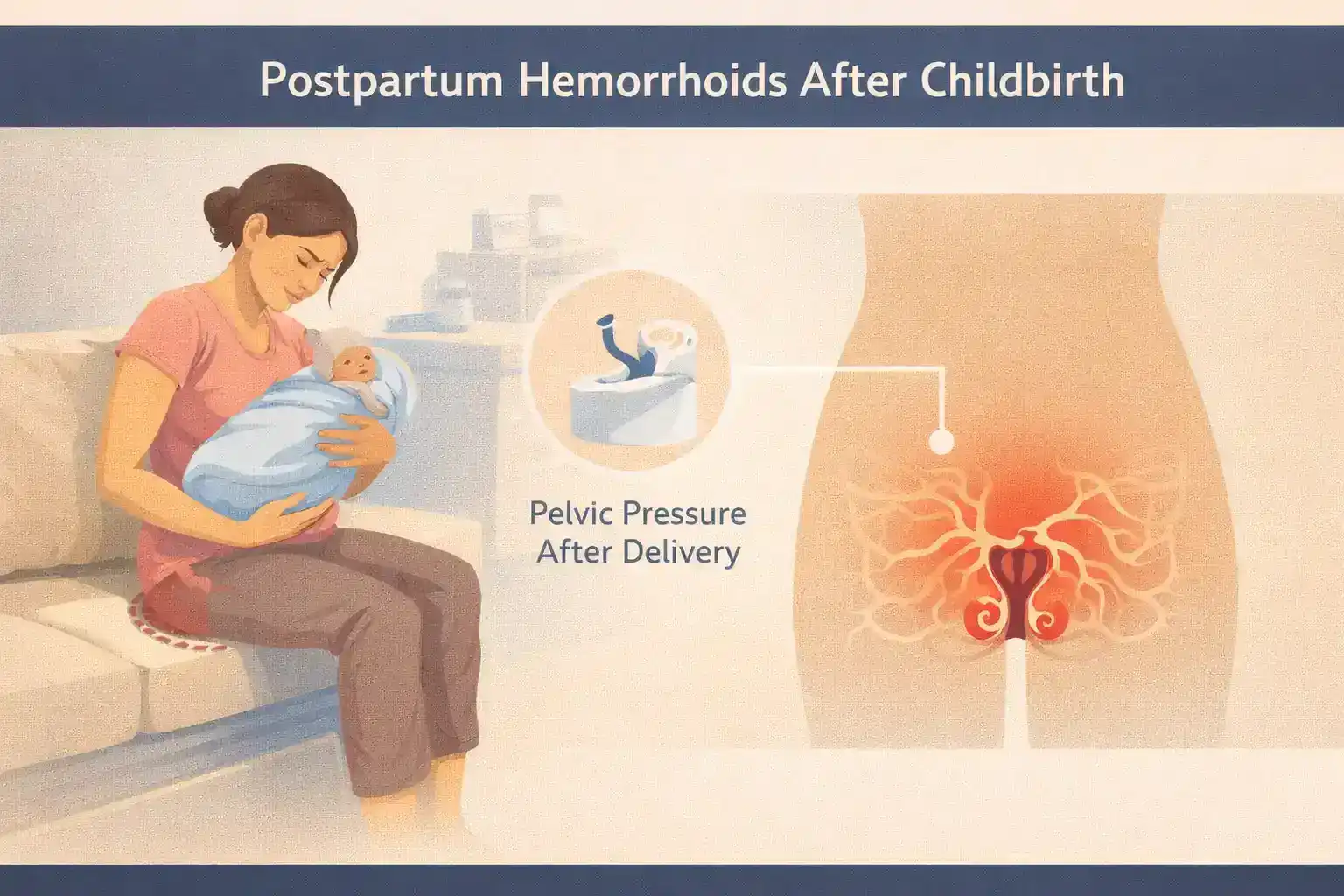
When Should a New Mother See a Doctor for Piles After Delivery?
The immediate postpartum period — the first 4 to 6 weeks — is a time when many women experience haemorrhoidal symptoms. The straining of labour, the pushing phase, and the immediate postpartum hormonal changes all contribute. Most Grade 1 and 2 haemorrhoids that develop or worsen during labour improve significantly within 4 to 8 weeks postpartum without any procedure.
Seek specialist postpartum piles treatment if: significant bleeding has not resolved after 4 to 6 weeks, there is a prolapsed pile that does not reduce on its own, pain is severe enough to interfere with normal care of the newborn, or a large thrombosed pile developed immediately after delivery. For comprehensive piles care, the postpartum assessment is a specific clinical consultation, not a general check-up.
What Postpartum Piles Treatments Are Safe While Breastfeeding?
| Treatment | Safe While Breastfeeding? | Notes |
|---|---|---|
| High-fibre diet + water | Yes — essential | Also supports milk production |
| Warm sitz baths | Yes | Twice daily, very effective |
| Ispaghol (psyllium) | Yes | Safe fibre supplement |
| Topical local anaesthetic cream | Generally yes — in moderation | Avoid steroid-containing preparations |
| Rubber band ligation | Yes after 6 weeks postpartum | No anaesthesia needed |
| Laser haemorrhoidoplasty | Generally deferred until weaning | Anaesthesia consideration |
Conservative measures and rubber band ligation are generally compatible with breastfeeding. Laser and open surgery are usually deferred until weaning to avoid anaesthetic medication exposure. The timing depends on the patient’s specific situation — a specialist advises on the optimal window. See piles assessment booking and bawaseer ka ilaj.
How Does Labour and Delivery Cause or Worsen Piles?
The second stage of labour — the pushing phase — involves maximal straining effort, often sustained over many contractions. This dramatically increases intra-abdominal and perineal venous pressure. Haemorrhoidal cushions engorge acutely. In patients who had Grade 1 or 2 piles before delivery, this can cause rapid progression to Grade 3 or 4. In patients with no prior history, acute symptomatic haemorrhoids can develop for the first time.
Instrumental deliveries — forceps or vacuum — are particularly associated with perineal trauma that can involve or worsen haemorrhoidal tissue. Caesarean section patients have lower rates of delivery-related haemorrhoid worsening, though they can still develop postpartum piles from constipation, iron supplementation, and reduced mobility. Kya aapki delivery normal thi ya instrumental? This affects the assessment. See evidence-based piles therapy.
What Is the Best Time to Get Definitive Piles Treatment After Delivery?
My standard recommendation: assess at 6 to 8 weeks postpartum. If symptoms are minimal and improving, continue conservative management. If Grade 2 or 3 persists, rubber band ligation from 6 weeks is appropriate and compatible with breastfeeding. For laser or open surgery, the ideal window is usually after weaning — typically 3 to 6 months postpartum — when anaesthesia is no longer a concern for the baby.
Some women wait until their family is complete before having definitive surgery — particularly for Grade 3, knowing that another pregnancy would likely worsen things again. This is a valid decision that I discuss with each patient based on their individual circumstances. See hemorrhoid treatment resources and how to know if your symptoms are piles.
Postpartum piles are common, manageable, and treatable — at the right time, with the right approach. New mothers do not have to add ongoing piles suffering to the demands of a newborn. Proper specialist care plans around your feeding, recovery, and family schedule.
🤔 Free Tool
Not Sure What Your Symptoms Mean?
Take our free 10-question symptom checker. Get an instant result — Piles, Fissure, Fistula, or Pilonidal Sinus — with treatment options and estimated cost.
▶ Free Symptom Check — Start NowUnder 2 minutes · Free · Instant result · No login required
Book Your Consultation
Want to discuss your symptoms with Dr. Abdullah Iqbal?
WhatsApp me directly on 0333-2877351. OPD timings: Tuesday, Thursday, Saturday — 5:00 PM to 8:00 PM at Karachi Piles Clinic, in Hill Park General Hospital, Shaheed-e-Millat Road, Karachi. Consultation fee Rs. 2,000.
🔗 Related Articles
🔗 Related Articles