Many patients come to me saying — doctor, mujhe dard hota hai but khoon nahi aata, toh kya ye bawaseer hai? It’s a fair question. Most people associate piles with bleeding. But in my experience, a significant number of piles patients have pain without any visible blood. And sometimes, the pain comes from a completely different condition altogether.
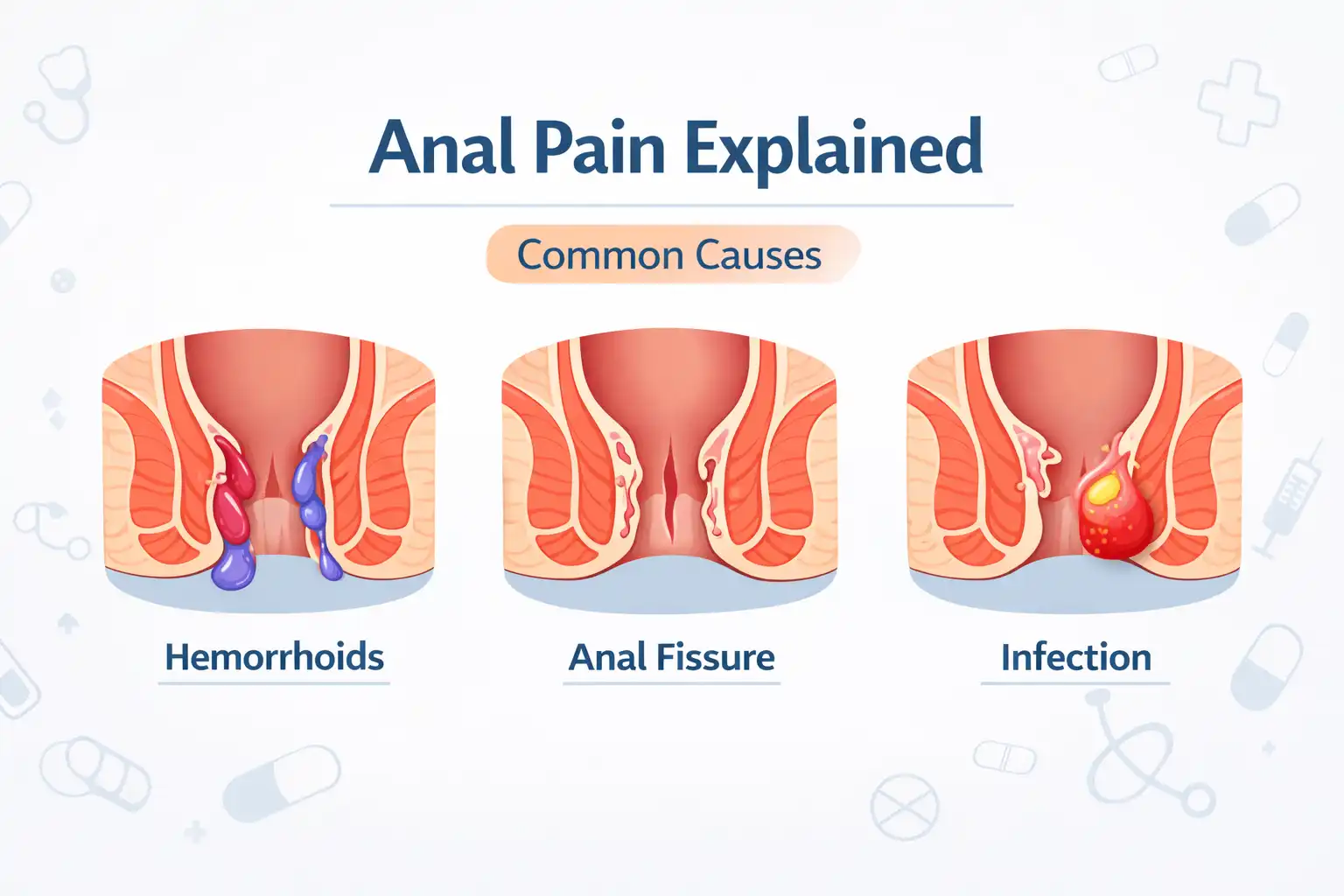
Can Piles Cause Anal Pain Without Any Bleeding?
Yes, they absolutely can. Internal piles, when they swell or prolapse, can cause a pressure sensation or dull ache inside the rectum. And external piles — especially when a clot forms inside them (what we call thrombosed piles) — can be extremely painful. No bleeding, just severe pain. I have seen patients almost unable to sit because of thrombosed external hemorrhoids.
But here is the important thing — anal pain without bleeding can also mean a fissure, a muscle spasm (called proctalgia fugax), an abscess forming, or even nerve-related pain. Each of these needs a different treatment. For professional consultation, do not try to self-diagnose. For more on this, see laser fissure treatment details.
What Are the Most Common Causes of Anal Pain Without Bleeding?
In my clinic, the causes I see most often are:
- Thrombosed external piles — a blood clot in an external hemorrhoid. Very painful, comes on suddenly
- Anal fissure — a small tear that causes sharp burning pain after motion, but may not bleed visibly every time
- Internal piles with prolapse — can cause pressure and ache without bleeding
- Proctalgia fugax — sudden, severe spasm of the rectal muscle, comes and goes quickly
Each of these is treated differently. That is why an examination is so important. Read more about minimally invasive laser piles surgery and what treatment approaches exist for each condition.
How Is Non-Bleeding Piles Treatment Different From Regular Piles Treatment?
| Piles With Bleeding | Non-Bleeding Piles (Pain-Only) |
|---|---|
| Often internal Grade 1-3 | Often external or thrombosed |
| Diagnosed easily by bleeding history | Requires careful examination to confirm |
| Responds to rubber banding or laser | Thrombosed type may need clot removal |
| Less urgent unless heavy | Thrombosed type is very urgent |
| Dietary changes help early stages | Pain management needed immediately |
In my opinion, non-bleeding piles treatment requires more careful assessment because the cause is less obvious. You cannot rely on one symptom alone.
What Does Persistent Rectal Discomfort Without Bleeding Usually Mean?
Persistent rectal discomfort — not sharp pain, just a constant ache or fullness — is something I see in patients with internal piles that have been present for a long time. The piles are large enough to cause pressure but not yet prolapsing visibly.
Also, this kind of discomfort can be a sign of levator ani syndrome — a muscle tension problem in the pelvic floor. It is more common than people realise, and it responds well to specific physiotherapy techniques. I sometimes refer patients for pelvic floor therapy alongside their proctological treatment.
Is this the same feeling you have been experiencing? Aisa lagta hai jaise andar kuch daba hua hai? That description is very common with internal piles. See diagnostic information to understand when it becomes urgent.
When Should Anal Pain Without Bleeding Be Treated as an Emergency?
Most anal pain is not an emergency. But some signs change that immediately. Go to a specialist the same day if you have anal pain that is:
- Sudden and severe — came on in minutes with no warning
- Associated with a new hard lump near the anus (could be thrombosed pile)
- Getting worse every hour, not better
- Accompanied by fever (could be abscess)
For more modern hemorrhoid management insights, please explore further. And if you are still working out who to actually see, my guide on the best piles specialist near you in Karachi walks through exactly what to look for.
What Home Measures Help With Anal Pain When You Cannot See a Doctor Immediately?
While waiting for your appointment, a few things can reduce the discomfort. Sitz baths — sitting in warm water for 10–15 minutes — help relax the anal sphincter and reduce swelling. Over-the-counter pain relief can help temporarily. Also, avoid sitting on hard surfaces for long periods, and do not strain during bowel movements.
But — and this is important — these are temporary measures. They do not treat the underlying cause. In my experience, patients who rely only on home remedies end up with a more advanced condition by the time they finally see a doctor. See all piles articles from KPC for lifestyle guidance alongside medical treatment.
Anal pain without bleeding is not something to push through silently. Your body is telling you something. Most cases are very treatable — the key is not waiting too long. Please also explore specialized pilonidal care if your pain is near the tailbone rather than the anus itself.
🤔 Free Tool
Not Sure What Your Symptoms Mean?
Take our free 10-question symptom checker. Get an instant result — Piles, Fissure, Fistula, or Pilonidal Sinus — with treatment options and estimated cost. For more on this, see laser fistulotomy and FiLaC details.
▶ Check Your Symptoms FreeUnder 2 minutes · Free · Instant result · No login required
Book Your Consultation
Considering laser treatment? Let’s talk about your case.
WhatsApp me directly on 0333-2877351. OPD timings: Tuesday, Thursday, Saturday — 5:00 PM to 8:00 PM at Karachi Piles Clinic, in Hill Park General Hospital, Shaheed-e-Millat Road, Karachi. Consultation fee Rs. 2,000.
🔗 Related Articles